If you’ve ever compared Korean makeup to Western makeup, you’ve probably noticed something interesting.
The eyeshadow often looks… lighter.
Softer.
Almost understated.
At first glance, it can even seem like there isn’t much eyeshadow at all.
Yet somehow the eyes still look defined, polished, and attractive.
This isn’t an accident.
In fact, one of the biggest differences between Korean makeup and many Western makeup styles is the philosophy behind the eyeshadow itself.
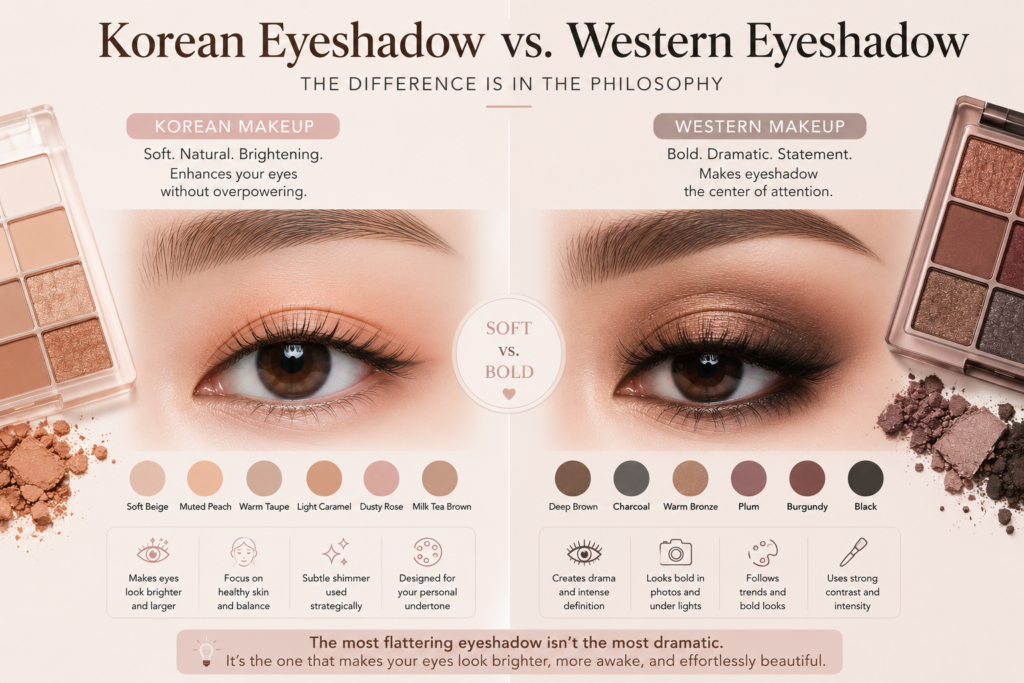
Rather than making the eyeshadow the star of the look, Korean makeup usually treats eyeshadow as a supporting element. The goal is often to make the eyes appear naturally brighter and larger without making it obvious that a lot of makeup was used.
That’s why softer shades dominate Korean beauty trends year after year.
While bold cut creases, dramatic smoky eyes, and intense color contrasts remain popular in many parts of the world, Korean makeup tends to favor shades that blend seamlessly into the skin.
Colors like:
- soft beige
- muted peach
- warm taupe
- light caramel
- dusty rose
- milk tea brown
appear repeatedly in Korean eyeshadow palettes.
They’re not designed to transform the face.
They’re designed to enhance it.
One reason for this is that softer colors tend to work on a wider range of eye shapes.
Many East Asian eye shapes have less visible lid space compared to the deep-set eye shapes often seen in Western beauty campaigns.
When very dark eyeshadow covers a smaller lid area, the eyes can sometimes appear heavier or smaller.
Lighter, softer shades help create depth without overwhelming the eye.
This is why many Korean makeup artists focus on gradual shading rather than dramatic contrast.
The result feels effortless even when considerable technique is involved.
Another reason softer eyeshadow became popular is that it photographs beautifully.
Harsh eyeshadow can create shadows that look dramatic in person but heavy in everyday photos.
Softer gradients tend to make the eyes appear cleaner and brighter in natural lighting.
This became especially important with the rise of selfies, social media, and smartphone photography.
When people see Korean beauty photos, they often think the skin is the main focus.
And they’re right.
Korean makeup traditionally prioritizes:
- healthy-looking skin
- brightness
- balance
- youthful features
rather than strong contour or dramatic eye makeup.
Because of this, eyeshadow often works quietly in the background.
The purpose is not to show off the eyeshadow itself.
The purpose is to make the entire face look fresher.
This also explains why glitter is used differently.
Western makeup trends often use bold metallics or dramatic shimmer across large areas of the lid.
Korean makeup tends to use tiny amounts of sparkle placed strategically.
A touch of shimmer near the center of the lid or the inner corner can make the eyes look brighter without creating a heavy makeup effect.
The overall result feels lighter and more natural.
Personal color analysis also plays a surprisingly large role.
Over the last decade, personal color consulting became extremely popular in South Korea.
As a result, many makeup brands started producing eyeshadow palettes designed around undertones rather than trends alone.
Today it’s common to see palettes specifically marketed toward:
- Spring Warm
- Summer Cool
- Autumn Warm
- Winter Cool
Instead of creating one palette for everyone, brands focus on helping people find colors that naturally harmonize with their complexion.
This is one reason Korean eyeshadow collections often contain subtle variations of similar shades.
What appears boring at first glance is actually carefully designed around color harmony.
And that’s where many people have a misunderstanding.
They assume Korean eyeshadow is simple because the colors are soft.
In reality, soft eyeshadow is often harder to create successfully.
When dramatic colors are removed, small details become much more important.
The undertone must be right.
The blending must be smooth.
The placement must suit the eye shape.
There is less room to hide mistakes behind bold color.
Perhaps that’s why softer eyeshadow continues to remain popular even as trends come and go.
It works.
Not because it’s dramatic.
But because it enhances the eyes without competing with them.
And for many people, that’s exactly what makes it so flattering.
The best eyeshadow isn’t always the one that gets noticed first.
Sometimes it’s the one that quietly makes someone look brighter, fresher, and more beautiful without anyone quite knowing why.
Leave a Reply