Have you ever looked at a skincare ingredient list and noticed a long, complicated name you couldn’t pronounce?
Many people focus on ingredients like hyaluronic acid, vitamin C, or collagen while completely overlooking one of the most important components in cosmetics: surfactants.
In fact, without surfactants, many of the skincare and beauty products we use every day simply wouldn’t work.
From facial cleansers and shampoos to micellar water and cleansing oils, surfactants play a crucial role in helping products remove dirt, oil, makeup, and impurities from the skin.
Yet they are also one of the most misunderstood ingredients in the beauty industry.
Some people believe all surfactants are harmful. Others have no idea what they actually do.
The truth is much more nuanced.
What Is a Surfactant?
A surfactant is a substance that helps water and oil mix together.
Normally, oil and water naturally separate. If you’ve ever seen salad dressing split into layers, you’ve witnessed this process firsthand.
Surfactants act as a bridge between these two substances.
Their molecular structure contains two different parts:
- A water-loving (hydrophilic) end
- An oil-loving (lipophilic) end
Because of this unique structure, surfactants can grab onto oil, dirt, makeup, and sebum while still allowing them to be rinsed away with water.
This is what makes effective cleansing possible.
Without surfactants, washing your face with water alone would remove very little oil or makeup.
Why Are Surfactants Used in Cosmetics?
Most cosmetic formulas contain ingredients that would not naturally stay mixed together.
Surfactants help solve this problem.
In skincare and cosmetics, surfactants are commonly used to:
- Remove dirt and excess oil
- Dissolve makeup
- Create foam
- Improve product texture
- Stabilize formulations
- Help ingredients spread evenly
This is why surfactants appear in products such as:
- Facial cleansers
- Body washes
- Shampoos
- Micellar waters
- Cleansing oils
- Creams and lotions
- Makeup removers
Even products that don’t foam may still contain surfactants.
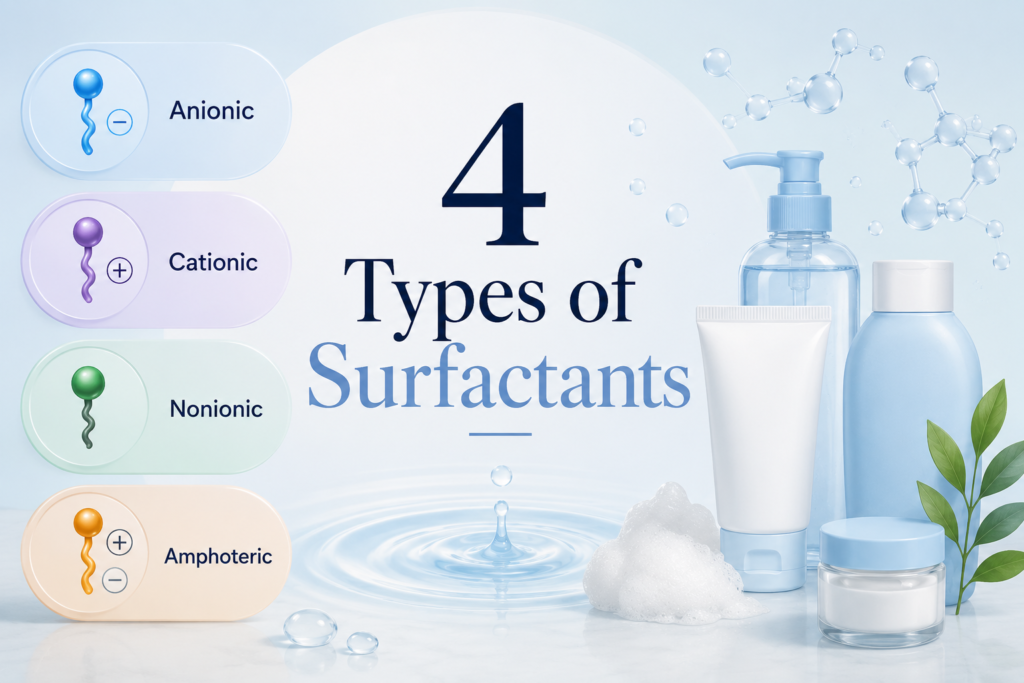
The Four Main Types of Surfactants
Not all surfactants behave the same way.
Chemists generally classify them into four categories.
Anionic Surfactants
Anionic surfactants provide strong cleansing power and create rich foam.
They are commonly found in:
- Facial cleansers
- Shampoos
- Body washes
Examples include:
- Sodium Lauryl Sulfate (SLS)
- Sodium Laureth Sulfate (SLES)
Advantages:
- Excellent cleansing ability
- Strong foam production
- Effective oil removal
Disadvantages:
- May feel drying for some skin types
- Can cause irritation in sensitive skin
Cationic Surfactants
Cationic surfactants carry a positive charge.
They are often used in hair care products because they help reduce static and improve softness.
Examples include:
- Behentrimonium Chloride
- Cetrimonium Chloride
Advantages:
- Conditioning effect
- Improved hair manageability
Disadvantages:
- Not commonly used as primary cleansers
Nonionic Surfactants
Nonionic surfactants are generally considered gentler.
They are frequently used in products designed for sensitive skin.
Examples include:
- Polysorbates
- Decyl Glucoside
- Coco Glucoside
Advantages:
- Mild cleansing
- Lower irritation potential
Disadvantages:
- Less foam production
- May feel less powerful for heavy makeup removal
Amphoteric Surfactants
These surfactants can behave as either positive or negative depending on the environment.
Examples include:
- Cocamidopropyl Betaine
Advantages:
- Gentle cleansing
- Often combined with stronger surfactants to reduce irritation
Disadvantages:
- Usually not used alone
Are Surfactants Bad for Your Skin?
One of the biggest myths in skincare is that all surfactants are harmful.
This simply isn’t true.
The effect of a surfactant depends on:
- The specific ingredient
- Its concentration
- The overall formula
- Your skin type
For example, a highly cleansing surfactant may work perfectly for oily skin but feel too harsh for dry or sensitive skin.
Modern skincare products often combine multiple surfactants to balance cleansing performance with skin comfort.
As a result, many cleansers today are significantly gentler than formulas from decades ago.
Surfactants and Sensitive Skin
People with sensitive skin often hear warnings about sulfates.
While sulfates can be drying for some individuals, they are not automatically harmful.
The real issue is whether the cleanser disrupts the skin barrier.
Signs a cleanser may be too harsh include:
- Tightness after washing
- Dry patches
- Increased redness
- Flaking
- Stinging sensations
If you experience these symptoms, switching to a milder surfactant system may be beneficial.
Ingredients such as Coco Glucoside and Decyl Glucoside are often found in gentler cleansers.
How Surfactants Work in Micellar Water
Micellar water provides an excellent example of surfactant technology.
Tiny surfactant molecules form structures called micelles.
These micelles surround oil, makeup, and dirt particles, allowing them to be lifted away from the skin without aggressive rubbing.
This is why micellar water can cleanse effectively while feeling surprisingly lightweight.
Choosing Products With the Right Surfactants
Rather than avoiding surfactants entirely, it’s better to choose products suited to your skin type.
For oily skin:
- Stronger cleansing systems may work well
For dry skin:
- Mild surfactants are often preferable
For sensitive skin:
- Look for gentle, fragrance-free formulations
The goal is effective cleansing without damaging the skin barrier.
Final Thoughts
Surfactants are one of the most important yet least understood ingredients in cosmetics.
They make cleansing possible, help products remain stable, and improve the overall user experience of many beauty products.
While some surfactants can be harsh when used improperly, modern cosmetic science offers a wide range of options designed for different skin types and needs.
Understanding surfactants is often the first step toward understanding how cosmetics actually work.
And once you begin recognizing these ingredients on product labels, skincare becomes much easier to navigate.
Leave a Reply