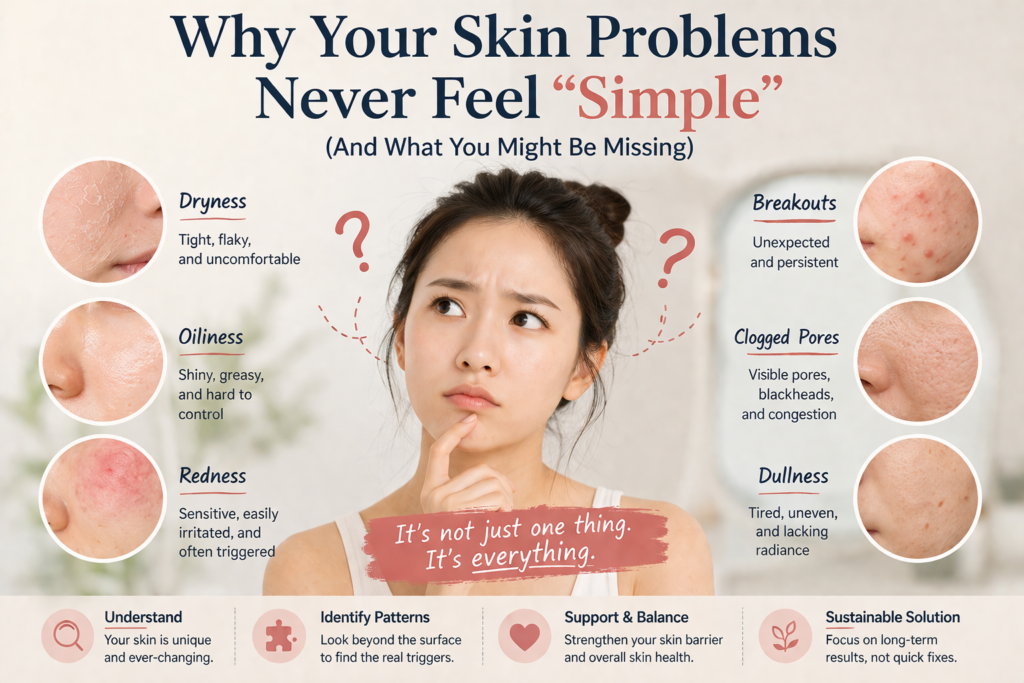
Why Your Skin Problems Never Feel “Simple” (And What You Might Be Missing)
There’s a pattern almost everyone goes through at some point.
You notice something on your skin.
A breakout.
Dry patches.
Sudden oiliness.
Or just a general feeling that your skin looks… different.
Not necessarily worse. Just not quite right.
So you start looking for answers.
You search. You read. You try something new.
And for a moment, it feels like you’re getting closer to understanding it.
But then something changes again.
The dryness improves—but now you’re breaking out.
The oil is gone—but your skin feels tight.
The redness fades—but your skin looks dull.
And suddenly, nothing feels simple anymore.
The Idea That Skin Problems Should Be “Easy”
One of the biggest assumptions people make is this:
👉 “If I can identify the problem, I can fix it.”
Dry skin? Use moisturizer.
Oily skin? Control oil.
Acne? Treat breakouts.
It sounds logical.
But real skin doesn’t work in isolated categories.
Your skin isn’t dealing with one thing at a time.
It’s reacting to everything at once.
Why Your Skin Doesn’t Fit Into One Category

Most people try to define their skin in a single word.
Dry.
Oily.
Sensitive.
But if you pay attention, your skin rarely behaves that consistently.
It might feel dry after washing—but oily by midday.
It might break out occasionally—but also feel tight at the same time.
That’s because your skin isn’t a fixed type.
👉 It’s a constantly adjusting system.
And those adjustments don’t always show up in predictable ways.
What Skin Concerns Actually Are
Instead of thinking in terms of “skin types,” it helps to shift the perspective.
Skin concerns are not labels.
They are signals.
Each concern—whether it’s dryness, oiliness, sensitivity, or breakouts—is your skin responding to something.
Not randomly.
But in reaction to:
- your environment
- your habits
- your products
- your internal balance
This is why treating the surface alone often feels incomplete.
The Overlap Most People Miss
Here’s where things get confusing.
Many skin concerns overlap.
And sometimes, they even contradict each other.
For example:
👉 Dry skin can still produce excess oil
👉 Oily skin can still be dehydrated
👉 Acne-prone skin can also be sensitive
This isn’t unusual.
It’s actually very common.
But when you approach each issue separately, it feels like nothing is working.
Because you’re treating symptoms in isolation.
Why Quick Fixes Rarely Last
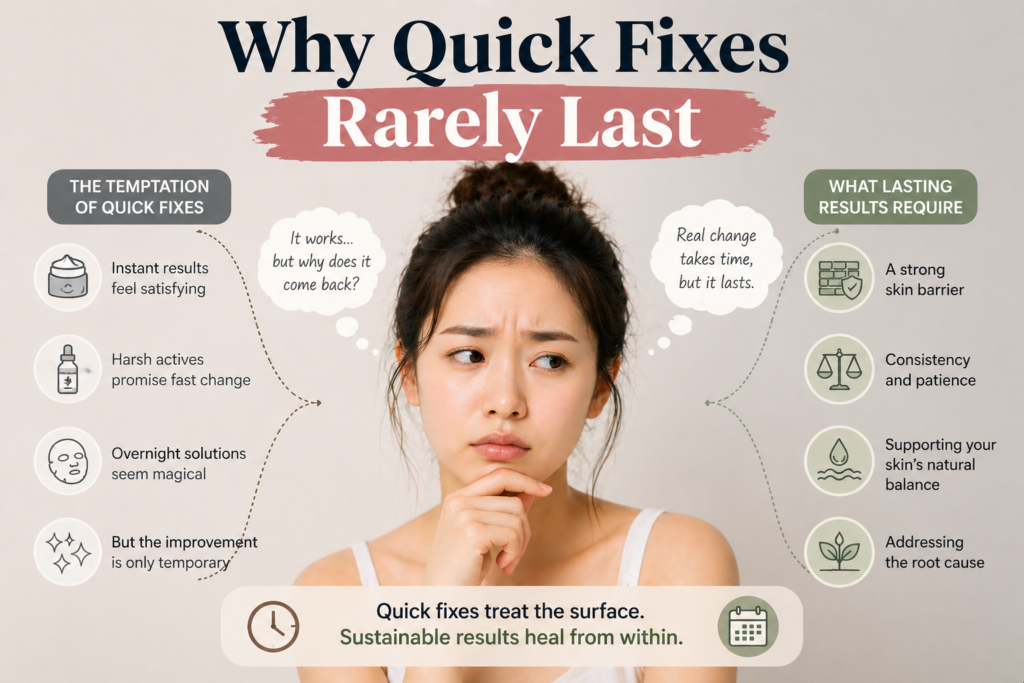
It’s tempting to look for immediate solutions.
Something that works fast.
Something that feels effective right away.
And sometimes, those things do exist.
But often, they solve only one part of the problem.
Not the underlying pattern.
So the result feels temporary.
Or inconsistent.
And that’s when frustration builds.
The Pattern Behind Most Skin Concerns
If you step back and look at your skin over time, patterns start to appear.
Not just what happens—but when it happens.
After certain products.
After certain habits.
During certain periods.
This is where real understanding begins.
Because your skin isn’t unpredictable.
It’s responsive.
A Different Way to Look at Skin
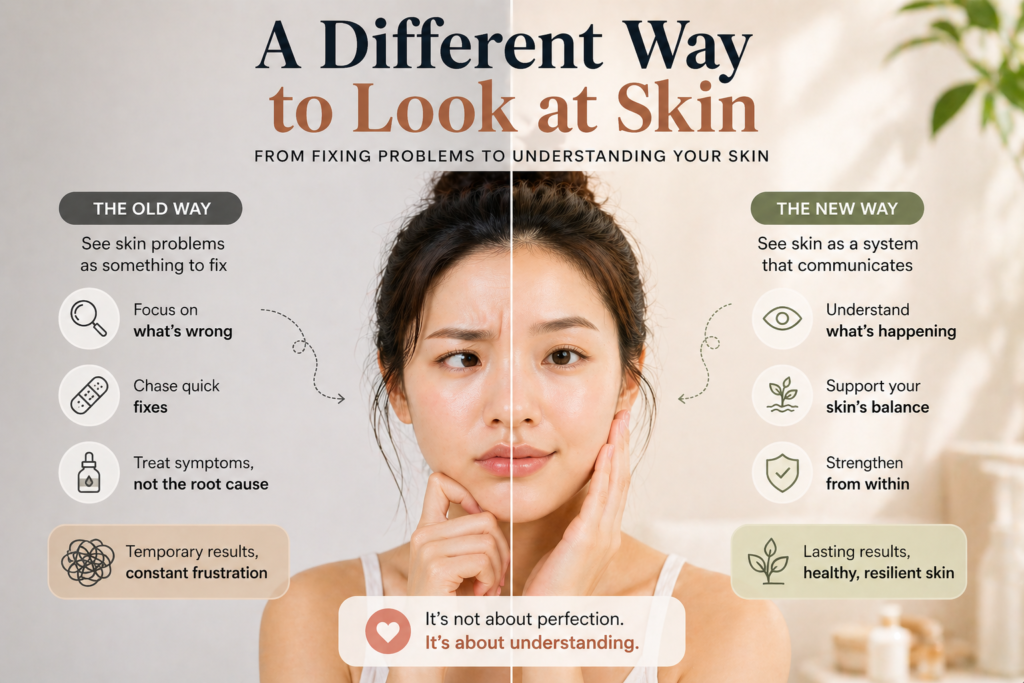
Instead of asking:
👉 “What problem do I have?”
Try asking:
👉 “What is my skin reacting to right now?”
That shift changes everything.
You stop chasing labels.
And start observing patterns.
Why This Matters More Than You Think
At first, this might feel like overthinking something simple.
But it actually makes things easier.
Because once you understand that your skin is dynamic—not fixed—you stop expecting perfect consistency.
And you start working with your skin, not against it.
What Comes Next
Understanding this is just the beginning.
Because once you recognize how complex skin concerns can be, the next step becomes clearer:
👉 learning how each concern works
👉 and how they connect to each other
That’s where things start to make sense.
Not instantly.
But gradually—and much more reliably.
Final Thoughts
Your skin problems aren’t complicated because something is wrong with you.
They feel complicated because your skin is doing its job—responding, adjusting, protecting.
And once you stop trying to simplify it too much, you start to understand it better.
Not all at once.
But enough to make better decisions, one step at a time.
Leave a Reply