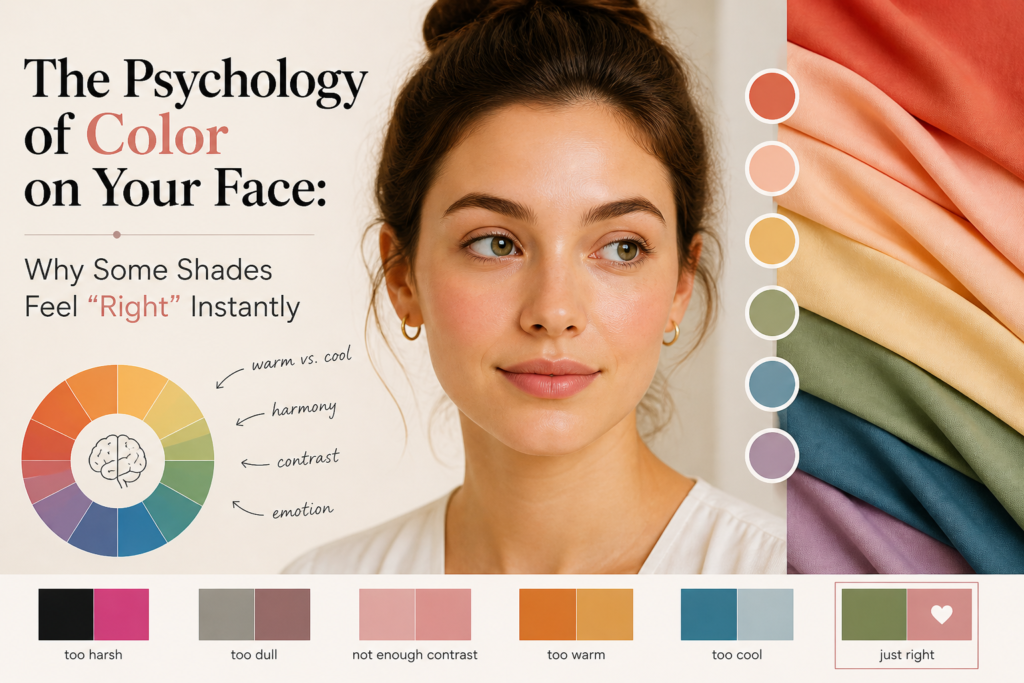
The Psychology of Color on Your Face: Why Some Shades Feel “Right” Instantly
There are moments when you try on a color and something feels immediately different.
Not dramatically. Not in an obvious, transformative way. But subtly—almost instinctively.
Your skin appears clearer. Your features look more defined. Your overall impression feels… right.
And yet, if someone were to ask you why, it might be difficult to explain.
This quiet, almost subconscious reaction is not accidental. It is rooted in how the human brain perceives color—especially when it is placed close to the face.
Understanding this is where personal color stops being just a styling tool, and begins to feel like something deeper: a psychological interaction between color and perception.
Color Is Not Just Seen—It Is Interpreted
We often think of color as a visual element. Something we “see.”
But in reality, color is something we interpret.
The brain constantly compares what it sees against internal expectations—contrast, balance, harmony. When a color aligns with those expectations, it feels natural. When it doesn’t, something feels slightly off.
This is why certain colors don’t just look different on you—they feel different.
A mismatched tone can make your skin appear dull, even when your skin itself hasn’t changed at all.
On the other hand, a well-matched tone doesn’t add anything new—it simply allows your natural features to come through more clearly.
The Face Is the Most Sensitive Area for Color Interaction
Color behaves differently depending on where it is placed.
A color on your shoes or bag may go unnoticed. But the same color, when placed near your face, interacts directly with your skin, your undertone, and even the natural shadows of your features.
This is why personal color analysis focuses almost entirely on the face.
Because this is where color has the most immediate psychological impact—not only on how others perceive you, but also on how you perceive yourself.
Why Some Colors Make You Look “Healthier”
There is a reason certain colors make your skin look more vibrant.
They don’t change your skin—they change how light reflects onto it.
Cool tones can enhance clarity and reduce the appearance of redness for some individuals.
Warm tones can bring warmth and softness, especially when they align with natural undertones.
When this alignment happens, the brain reads the overall image as more balanced—and interprets that balance as “healthy.”
It’s not about perfection. It’s about harmony.
Why Some Colors Feel Uncomfortable (Even If You Like Them)
One of the most common experiences is liking a color, but not liking how it looks on you.
This is not about taste—it is about contrast.
When a color does not match your undertone or natural depth, the brain detects a mismatch.
The result is often subtle:
- your skin may look slightly uneven
- shadows may appear more pronounced
- your features may lose definition
Even if you cannot identify the exact issue, the overall impression feels less cohesive.
And that subtle discomfort is what many people describe as “this color doesn’t suit me.”
Familiarity vs Accuracy
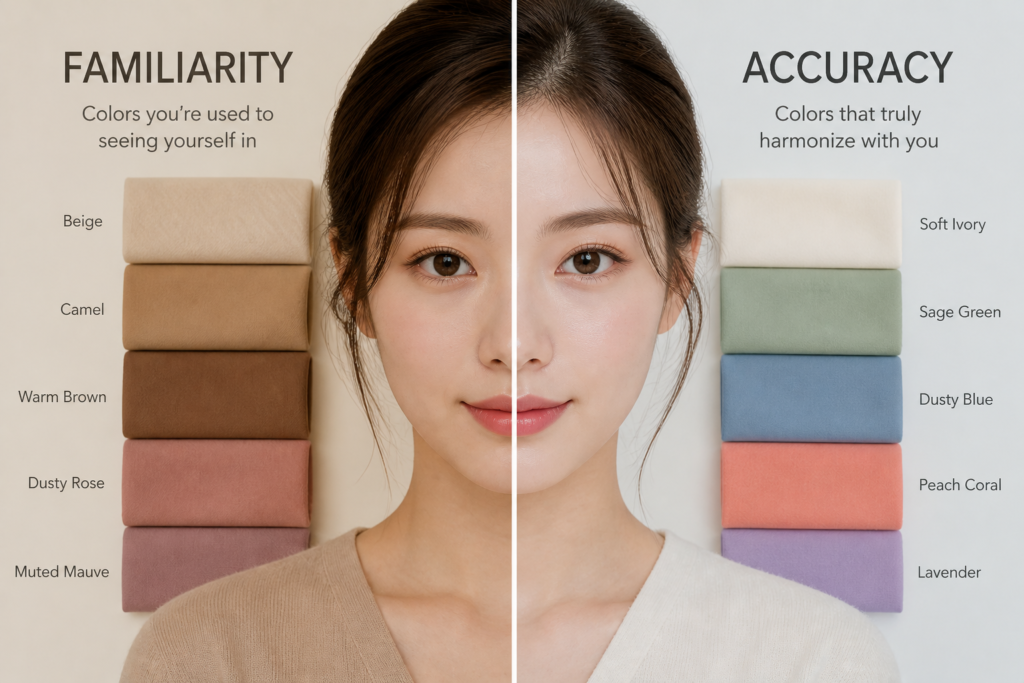
Interestingly, what feels “right” is not always what is most accurate.
Many people become accustomed to certain colors over time—due to trends, habits, or availability.
These colors feel familiar, and therefore comfortable.
But familiarity does not always equal harmony.
When you first try a color that truly matches your personal tone, it may feel unfamiliar.
Softer. Less dramatic. Sometimes even slightly underwhelming at first.
But over time, that subtle balance often becomes more natural than the colors you were used to before.
Why Personal Color Feels Personal
Personal color is not just about categories like “warm” or “cool.”
It is about how color interacts with your unique combination of:
- skin tone
- undertone
- natural contrast
- facial structure
This is why two people wearing the same color can create entirely different impressions.
The color itself does not change. The perception does.
A Shift in Perspective
Instead of asking, “Do I like this color?”
A more useful question might be:
👉 “What does this color do to my face?”
Does it bring clarity, or does it create distraction?
Does it support your features, or compete with them?
When you begin to see color this way, personal color becomes less about rules—and more about awareness.
Final Thoughts
Color has always been a part of how we present ourselves.
But its effect goes beyond aesthetics.
It influences perception. It shapes first impressions. And perhaps most importantly, it changes how we see ourselves in the mirror.
Not by transforming who we are—but by either revealing or obscuring what is already there.
And that is why some colors don’t just look good.
They feel right.
Leave a Reply