How to Find Your Personal Color at Home (A Simple but Surprisingly Accurate Guide)
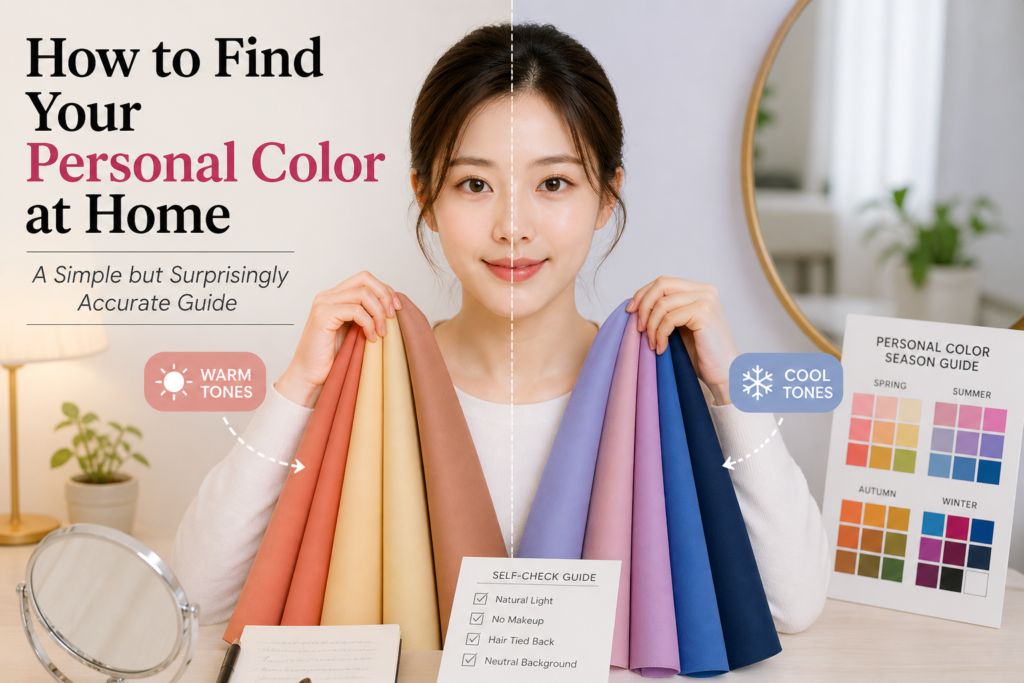
After understanding how color affects the way your face is perceived, the next question becomes inevitable:
“How do I actually find my personal color?”
Professional analysis can be helpful, but it is not the only way. In fact, many of the key signals your skin gives are already visible—you just need to know how to read them.
Finding your personal color at home is less about following strict rules, and more about observing subtle changes.
Once you start noticing them, the difference becomes surprisingly clear.
Start With the Right Conditions
Before you begin, it’s important to remove as many variables as possible.
Natural light is essential.
Artificial lighting can distort color perception, making warm tones appear cooler or vice versa. Stand near a window, preferably during the daytime, with soft, indirect light.
Next, remove makeup.
Even a light layer of foundation can alter how colors interact with your skin. What you want to observe is your natural tone—not a corrected version of it.
Hair can also influence perception.
If your hair color is strong or dyed, try pulling it back so that it does not interfere with the test.
The Fabric Test: The Most Reliable Method
One of the simplest and most effective ways to identify your personal color is the fabric test.
Gather a few pieces of clothing or fabric in clearly different tones:
- warm (orange, peach, mustard)
- cool (blue, lavender, pink)
Hold each color close to your face and observe carefully.
You are not looking for which color you “like” more.
Instead, focus on what happens to your skin.
Ask yourself:
- Does your skin look clearer or duller?
- Do shadows under your eyes become more visible?
- Does your complexion look more even?
The right color will not stand out—it will allow your face to look more balanced.
Gold vs Silver: A Quick Indicator
Another widely used method is the gold vs silver test.
Hold gold and silver jewelry near your face, one at a time.
Gold tends to enhance warmth, while silver enhances coolness.
If your skin appears brighter and more even with gold, you may lean warm.
If silver creates a cleaner, more refined look, you may lean cool.
However, this is not always definitive.
Some people fall somewhere in between, and both may look acceptable.
In that case, you may have a neutral undertone.
Pay Attention to Contrast, Not Just Color
Many people focus only on tone (warm vs cool), but depth and contrast also matter.
For example, darker, more saturated colors may overpower softer features, even if the undertone matches.
Similarly, very light or muted colors may wash out someone with naturally higher contrast.
This is why personal color is not just about picking “warm” or “cool”—it is about finding the balance that works with your natural intensity.
Common Mistakes to Avoid
One of the biggest mistakes is relying solely on preference.
We tend to gravitate toward colors we are familiar with, not necessarily the ones that suit us best.
Another mistake is testing under inconsistent lighting.
A color that looks flattering indoors may appear completely different in daylight.
Finally, avoid overanalyzing small differences.
Personal color is not about finding perfection—it is about noticing patterns.
If one group of colors consistently makes your skin look clearer, that is already a strong indicator.
What If You’re Still Not Sure?
It is completely normal to feel uncertain at first.
Personal color is subtle, and it takes time to train your eye.
If you find that both warm and cool tones seem to work, you may fall into a neutral category.
In this case, the focus shifts from strict classification to flexibility—choosing colors based on overall harmony rather than rigid rules.
A More Practical Way to Think About It
Instead of trying to label yourself immediately, focus on building awareness.
Notice which colors make you look more rested.
Pay attention to how your skin reacts to different shades over time.
The goal is not to fit into a category, but to understand how color interacts with your face.
Once that awareness develops, identifying your personal color becomes less about guessing—and more about recognition.
Final Thoughts
Finding your personal color at home is not about achieving a perfect diagnosis.
It is about learning to see.
The more you observe, the more intuitive it becomes.
And once you recognize what works for you, choosing colors becomes less complicated—and far more intentional.
Because in the end, the most effective color is not the one that stands out.
It’s the one that lets you come through.
Leave a Reply