Warm Tone vs Cool Tone: The Easiest Way to Tell (Without Overthinking It)
At some point, almost everyone who becomes interested in personal color encounters the same question:
“Am I warm or cool?”
It sounds simple. Almost binary. As if the answer should be immediate and obvious.
But in reality, this is where many people begin to feel confused.
Because while the concept of warm and cool tones is widely discussed, the way it is often explained tends to be either too technical or overly simplified.
The result is hesitation. Second-guessing. And sometimes, complete uncertainty.
The truth is, identifying your tone does not require complex analysis.
What it requires is observation—specifically, knowing what to look for, and more importantly, what not to overthink.
What Warm and Cool Really Mean
Before trying to identify your tone, it is important to understand what these terms actually refer to.
Warm and cool do not describe the color of your skin on the surface.
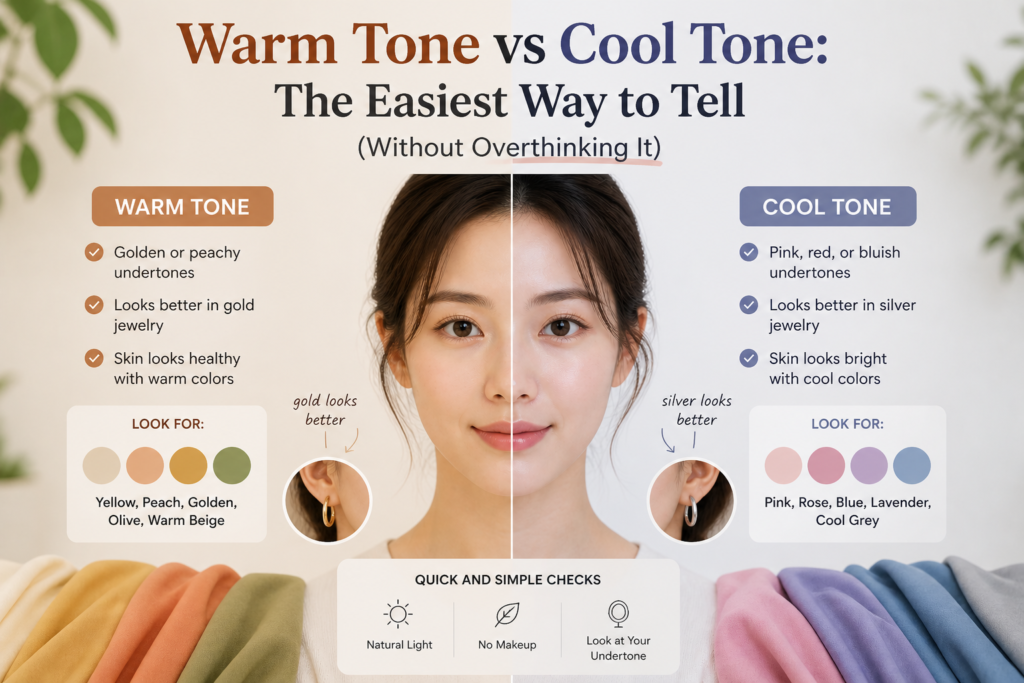
They describe your undertone—the subtle hue that sits beneath the visible layer of your skin.
Warm undertones typically lean toward:
- yellow
- peach
- golden
Cool undertones often lean toward:
- pink
- red
- bluish
This undertone remains relatively stable, even if your skin tone changes due to sun exposure or seasonal shifts.
That is why two people with similar skin brightness can look completely different when wearing the same color.
The Most Reliable Way: Observing Skin Reaction
Rather than trying to categorize yourself immediately, a more effective approach is to observe how your skin reacts to different tones.
Take two clearly different colors:
- one warm (such as soft orange or coral)
- one cool (such as lavender or icy pink)
Hold each color near your face under natural lighting.
Then look for changes—not in the color itself, but in your skin.
With the right tone, your skin tends to:
- appear clearer
- look more even
- reflect light more naturally
With the wrong tone, subtle imbalances appear:
- shadows become more noticeable
- redness or dullness increases
- your overall expression may seem slightly tired
The key is not which color looks stronger, but which one allows your face to look more balanced.
Why the Answer Is Not Always Obvious
Many people expect a dramatic difference between warm and cool tones.
But in reality, the difference is often subtle.
Especially if you:
- have a neutral undertone
- are used to wearing a wide range of colors
- are observing under inconsistent lighting
In these cases, both warm and cool tones may seem acceptable, which makes the decision feel more difficult than it actually is.
This is why trying to “force” a clear answer can sometimes be counterproductive.
The Role of Contrast and Intensity
Another factor that often complicates tone identification is contrast.
Some people naturally have softer features, while others have stronger, more defined contrast between their skin, hair, and eyes.
A color may match your undertone, but if it is too intense—or too muted—it may still feel off.
For example:
- a bright warm color may overpower a soft warm undertone
- a muted cool color may flatten someone with higher contrast
This is why personal color is not only about temperature, but also about depth and clarity.
Quick Tests—And Their Limitations
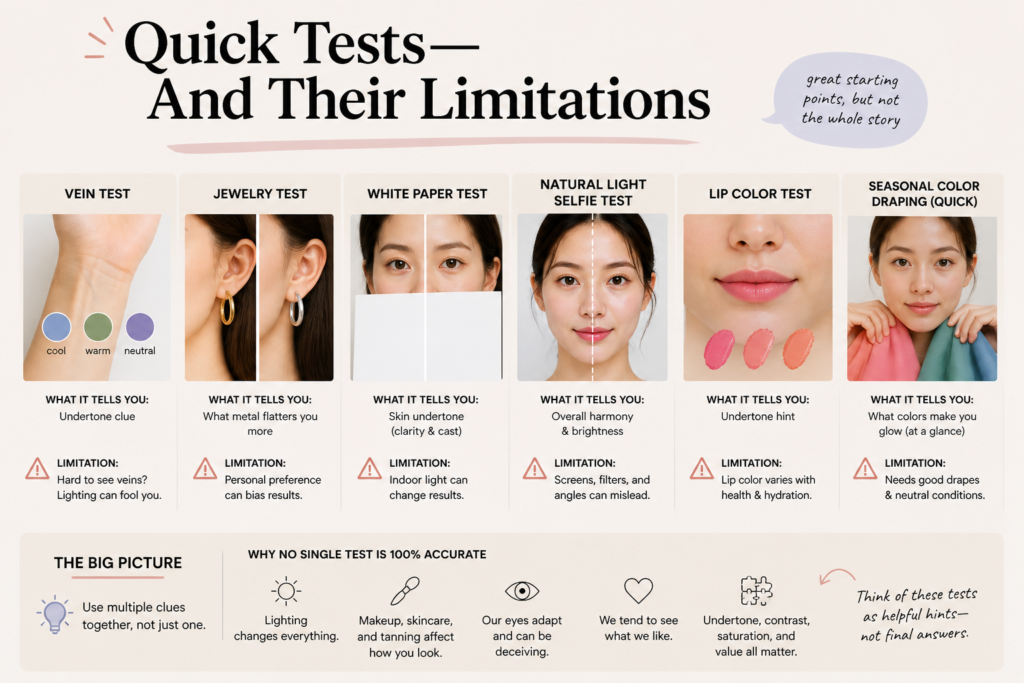
You may have heard of quick tests such as:
- the vein test
- the gold vs silver test
- the white shirt comparison
While these can offer hints, they are not always definitive.
Veins, for example, can appear blue or green depending on lighting and skin thickness.
Jewelry preference can be influenced by personal style rather than undertone.
These methods are useful as references, but they should not replace direct observation.
What If You Feel Like Both?
If you find yourself thinking, “Both seem fine,” you are not alone.
Many people fall into what is often described as a neutral undertone.
This means your skin does not strongly lean toward either warm or cool, allowing you to wear a broader range of colors.
In this case, the focus shifts from strict classification to overall harmony.
Instead of asking, “Am I warm or cool?”
A more useful question becomes:
👉 “Which colors make my face look more balanced?”
A Simpler Way to Decide
If the process feels overwhelming, simplify it.
Stand in front of a mirror in natural light.
Hold two different tones near your face.
Then ask:
- Which one makes my skin look more even?
- Which one reduces visible shadows?
- Which one feels more effortless?
The answer may not be dramatic—but it will be consistent.
And consistency is more reliable than intensity.
Final Thoughts
Warm vs cool is often treated as the starting point of personal color.
But in many ways, it is more of a reference point than a final answer.
Understanding your tone helps guide your choices, but it does not define them completely.
Because ultimately, personal color is not about fitting into a category.
It is about recognizing what works with your natural features—and why.
And once you begin to see those patterns, the question of warm or cool becomes less about guessing…
and more about understanding.
Leave a Reply