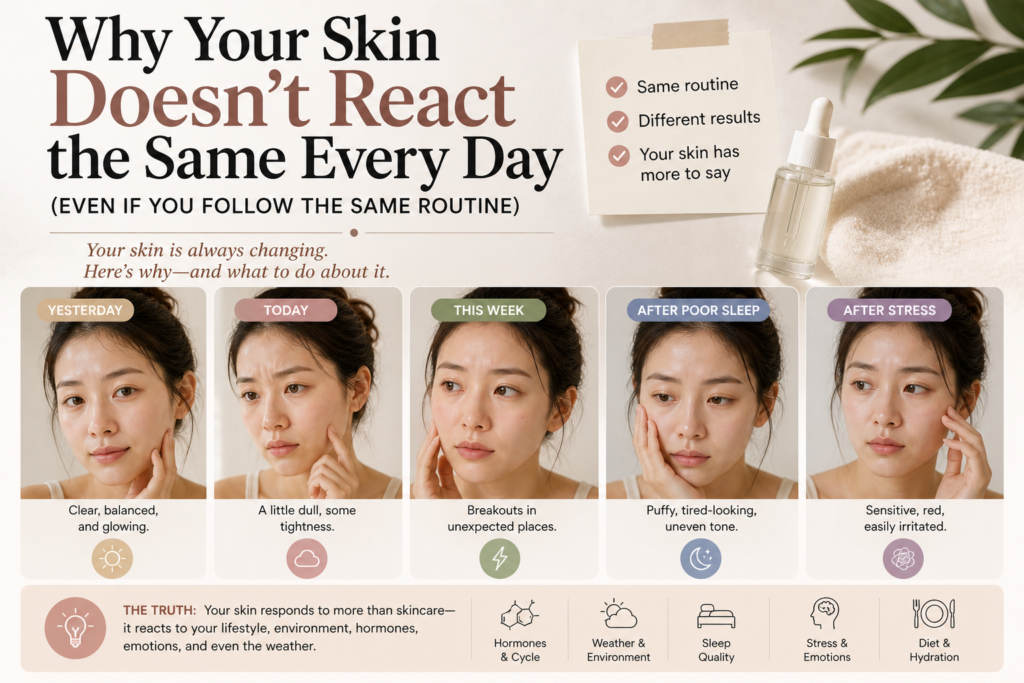
There’s a quiet frustration that most people eventually run into, especially if they’ve spent any time trying to “figure out” their skin.
You find a routine that seems to work. You stick to it. The same cleanser, the same moisturizer, the same careful steps every morning and night. For a while, everything feels under control—balanced, predictable, almost reassuring.
And then, without warning, your skin changes.
It might feel drier than usual. Or suddenly oilier. A breakout appears in a place that was completely clear just days ago. The texture shifts, the tone looks uneven, and whatever confidence you had in your routine starts to feel… uncertain.
The instinct is to blame the product. Or yourself. Maybe you skipped a step, ate something different, didn’t drink enough water.
But more often than not, the explanation is simpler—and more complex—at the same time.
Your skin isn’t static.
It’s responsive.
Your Skin Is Not a Fixed Type—It’s a Daily Condition
We often talk about skin as if it belongs to a category: dry, oily, combination, sensitive. It sounds clean and organized, the kind of definition that makes decision-making easier.
But in reality, your skin behaves more like a system than a label.
On any given day, it’s reacting to a combination of internal signals—hormones, stress levels, sleep quality—and external conditions like weather, humidity, temperature, and even the air around you.
A routine that feels perfect on a calm, well-rested morning might feel completely off after a few nights of poor sleep. The same moisturizer that once felt rich and comforting can suddenly feel heavy or insufficient, depending on what your skin is going through.
This isn’t inconsistency.
It’s adaptability.
Your skin is constantly adjusting, trying to maintain balance in an environment that is always shifting. And sometimes, that adjustment shows up in ways that feel unpredictable.
Small Changes Add Up Faster Than You Think
What makes this even more confusing is that the changes are rarely dramatic on their own.
It’s not one thing that throws your skin off—it’s the accumulation.
A slightly colder day. A bit more stress than usual. One night of reduced sleep. Maybe a small change in diet, even something you wouldn’t normally pay attention to.
Individually, none of these factors seem significant.
Together, they create a different environment for your skin.
And your skin responds accordingly.
Oil production might increase to compensate for dryness in the air. Or your barrier function might weaken just enough to make your skin feel more sensitive than usual. A product that worked perfectly before now feels like it’s “not enough” or “too much,” not because the product changed, but because your skin did.
This is where many routines begin to fail—not because they’re wrong, but because they’re too rigid.
They assume stability in something that is inherently dynamic.
What Actually Works: Responding Instead of Controlling
The idea of a “perfect routine” is appealing because it promises control. Follow these steps, use these products, and your skin will behave.
But the more useful approach is often less about control and more about awareness.
Instead of asking, “What should I always use?”, a better question might be, “What does my skin need today?”
Some days, that might mean keeping things simple—gentle cleansing, minimal layers, giving your skin space to recover. Other days, it might benefit from added hydration, or a slightly richer texture that supports its barrier.
The difference is subtle, but important.
You’re not abandoning consistency. You’re refining it.
Consistency becomes less about repeating the exact same steps and more about maintaining a consistent level of attention—an ability to notice when your skin is shifting and respond before small imbalances turn into bigger problems.
Over time, this creates a different kind of confidence.
Not the kind that comes from finding a routine and never changing it, but the kind that comes from understanding your skin well enough to adjust without overreacting.
Because the goal isn’t to make your skin behave the same way every day.
It’s to understand why it doesn’t—and know what to do when it changes.
Leave a Reply