There’s a moment most people experience at some point in their skincare journey.
You find a product that works. Not just “okay,” but genuinely works. Your skin looks calmer, more even, more balanced. It becomes part of your routine—something you trust, something you don’t question.
And then one day, without any obvious reason, it stops feeling the same.
The texture feels off. The results aren’t as noticeable. Or worse, your skin reacts in a way it never did before. Suddenly, the product you relied on feels unpredictable.
The instinct is immediate: maybe the formula changed, maybe your skin “got used to it,” or maybe it just isn’t as good as you thought.
But the truth is more subtle.
In most cases, the product didn’t change.
Your skin did.
Your Skin Is Not Reacting to the Product Alone
It’s easy to think of skincare as a direct relationship—product goes on, result comes out. Clean cause and effect. But your skin doesn’t work like a controlled experiment.
It’s responding to multiple variables at the same time.
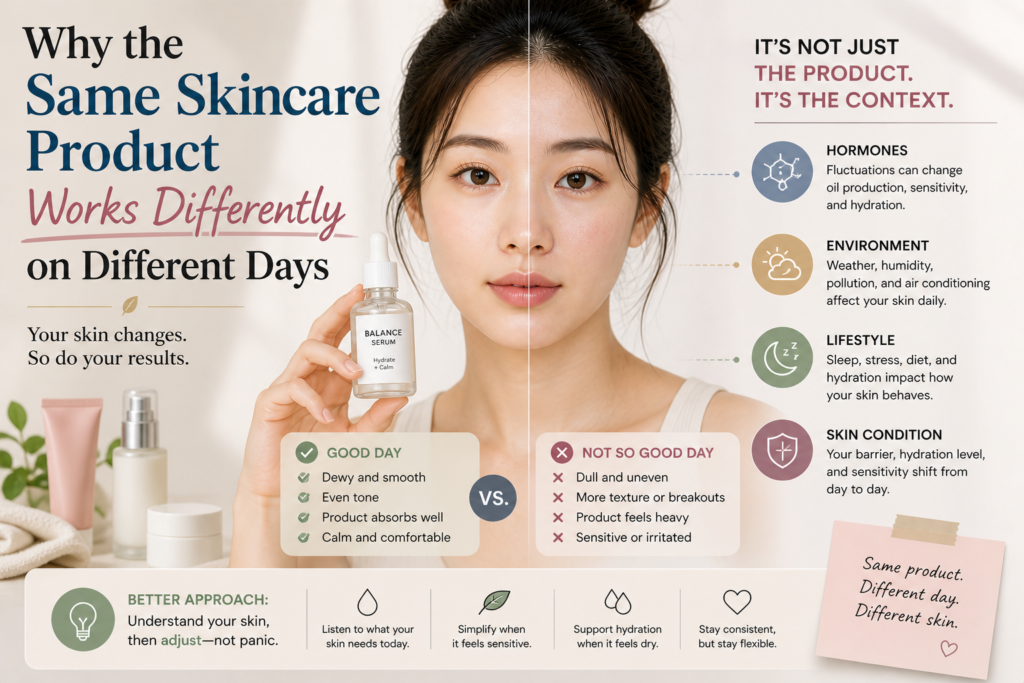
The condition of your skin barrier, your hydration level, your oil production, even how sensitive your skin is on that particular day—all of these factors influence how a product performs.
A hydrating serum, for example, may absorb beautifully and leave your skin feeling smooth on one day. On another day, when your barrier is slightly compromised or your skin is dehydrated at a deeper level, the same serum might feel like it’s just sitting on top, doing very little.
The product hasn’t lost its effectiveness.
It’s simply interacting with a different version of your skin.
Timing, Environment, and Internal Changes Matter More Than You Think
One of the most overlooked factors in skincare is timing—not in terms of morning or night, but in terms of your body’s current state.
Hormonal fluctuations alone can change how your skin behaves within a matter of days. Oil production can increase, sensitivity can spike, and your skin’s ability to retain moisture can shift without you consciously noticing.
Then there’s the environment.
A slight drop in temperature. Lower humidity. More time spent in air-conditioned spaces. Even something as small as these changes can alter how your skin holds onto hydration or reacts to active ingredients.
And of course, lifestyle quietly plays its role.
Less sleep than usual, increased stress, or even subtle dietary changes can all influence how resilient—or reactive—your skin feels. These aren’t dramatic shifts, but they accumulate. And your skin reflects that accumulation faster than you expect.
So when a product feels different, it’s rarely about the product failing.
It’s about context changing.
What Works Better Than Switching Products Constantly
When something stops “working,” the natural reaction is to replace it. Try something stronger, something newer, something that promises better results.
But constantly switching products often creates more instability, not less.
A more effective approach is to pause and ask a different question.
Instead of “Is this product still good?”, ask, “What condition is my skin in today?”
If your skin feels more sensitive than usual, it may not need more actives—it may need less. If it feels tight or dull, it might be lacking hydration at a deeper level, not just surface moisture. If breakouts appear, your skin might be reacting to internal stress rather than external products.
In other words, the same product can still work—but only when it’s used in the right context.
Consistency in skincare isn’t about using the exact same things every day without question.
It’s about understanding when to simplify, when to support, and when to adjust.
Because the goal isn’t to find one product that works forever, in every situation.
It’s to understand your skin well enough that when something changes, you don’t immediately assume something is wrong—you recognize that your skin is simply responding, adapting, and asking for something slightly different.
Leave a Reply