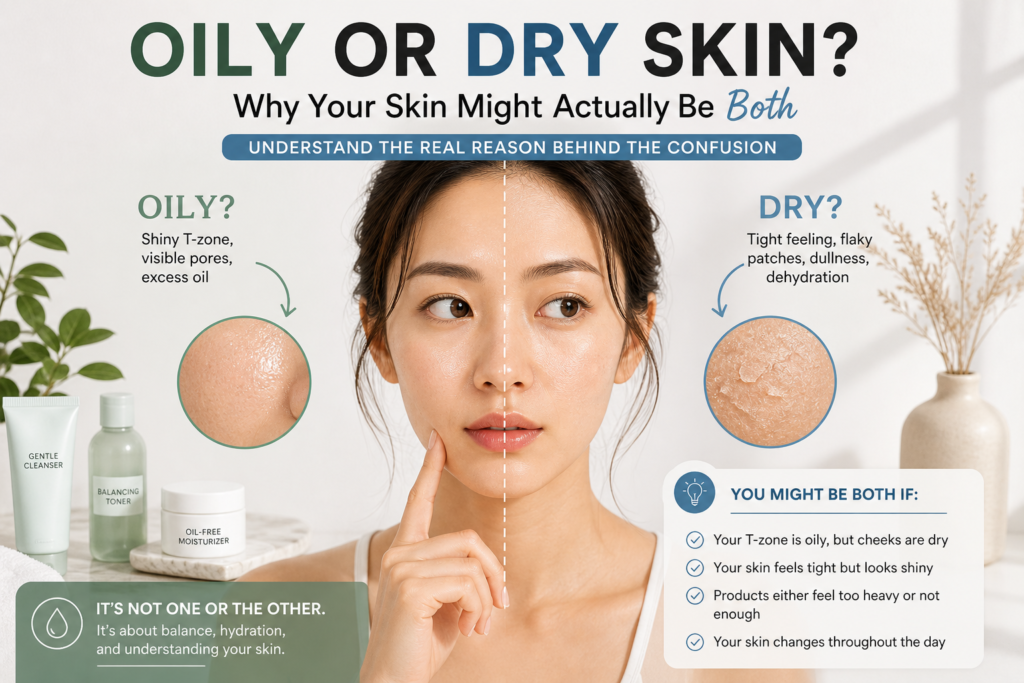
At some point, almost everyone tries to answer what feels like a simple question: “Is my skin oily or dry?”
It sounds straightforward, the kind of thing you should be able to figure out after a few days of paying attention. Maybe your skin feels shiny by midday, or tight after washing. Maybe you’ve already labeled yourself as one or the other and built your routine around that assumption.
But then something doesn’t quite add up.
Your T-zone gets oily, but your cheeks feel dry. Or your skin looks shiny, yet somehow still feels tight underneath. You switch to products for oily skin, and suddenly your face feels uncomfortable. You try hydrating formulas, and now it looks greasy.
The more you try to simplify your skin into one category, the more confusing it becomes.
And that’s because the question itself might be too limited.
Your Skin Can Be Oily and Dry at the Same Time
We tend to think of oil and dryness as opposites. If your skin produces oil, it shouldn’t be dry—at least, that’s what seems logical. But in reality, oil and hydration are not the same thing.
Oil comes from your sebaceous glands. Hydration, on the other hand, refers to the water content in your skin.
You can have plenty of oil on the surface while still lacking hydration underneath.
This is often what people describe as “oily but dry” skin. The skin produces oil as a way of protecting itself, but if the deeper layers are dehydrated or the barrier is slightly compromised, that oil doesn’t translate into comfort or balance.
Instead, you get that familiar combination: shine on the surface, tightness beneath it.
It’s not a contradiction. It’s a signal.
Your skin isn’t choosing between oily or dry—it’s trying to compensate.
Why Your Skin Ends Up in This In-Between State
This mixed feeling doesn’t usually come from just one cause. It’s the result of small imbalances building over time.
Over-cleansing is one of the most common triggers. When the skin is stripped too aggressively, it loses not just oil, but also moisture. In response, it produces more oil to protect itself, creating a surface-level shine that doesn’t solve the underlying dryness.
Environmental factors play a role as well. Air conditioning, cold weather, and low humidity can quietly pull moisture out of your skin, even if you don’t immediately notice it.
And then there’s your daily routine—sleep, stress, hydration, diet. These don’t change your skin overnight, but they shift how resilient your skin feels. When your skin barrier is slightly weakened, even familiar products can start to feel less effective.
So when your skin feels both oily and dry, it’s rarely random.
It’s usually the result of your skin trying to maintain balance in less-than-ideal conditions.
What Actually Helps (Without Overcorrecting)
The biggest mistake people make at this stage is trying to “fix” one side of the problem while ignoring the other.
If your skin looks oily, the instinct is to remove that oil. Strong cleansers, mattifying products, anything that promises to reduce shine. But when oil is being produced as a response to dehydration, stripping it further often makes the cycle worse.
On the other hand, layering heavy creams without addressing how your skin is absorbing moisture can leave it feeling congested rather than balanced.
What tends to work better is a more measured approach.
Gentle cleansing that doesn’t disrupt your barrier. Lightweight hydration that actually sinks in, rather than sitting on the surface. And most importantly, paying attention to how your skin feels—not just how it looks.
Some days, your skin may lean slightly oilier. Other days, it might feel tighter. The goal isn’t to force it into one fixed category, but to support it in a way that adapts to those shifts.
Because once you stop trying to label your skin too strictly, something interesting happens.
It becomes easier to understand.
And when you understand it better, you stop overcorrecting—and start working with it instead of against it.
Leave a Reply