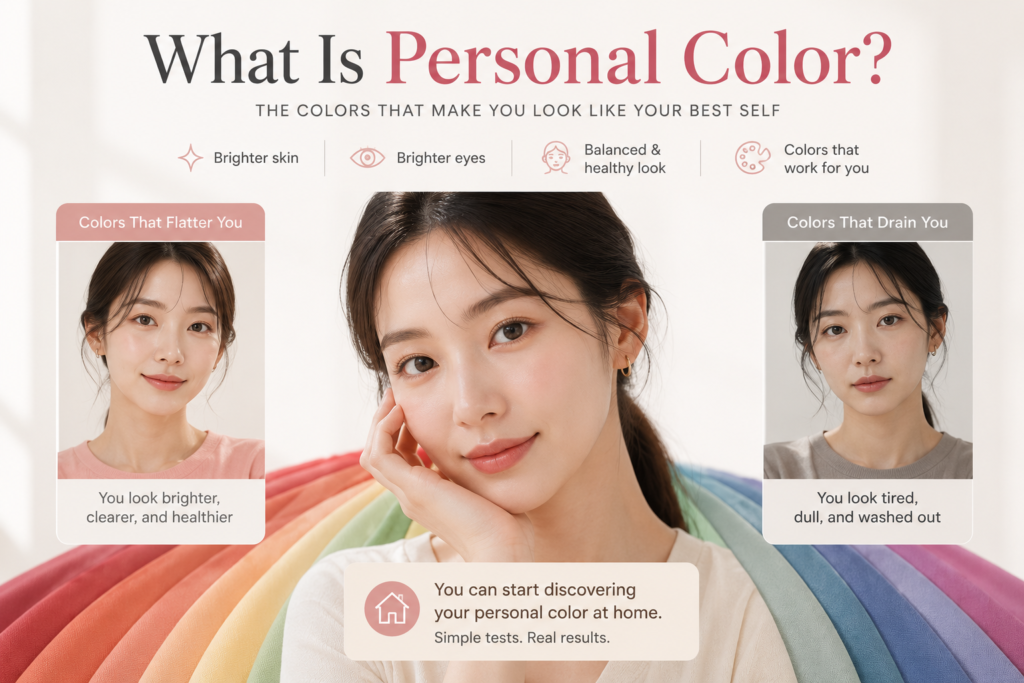
Have you ever worn a certain color and suddenly felt like your skin looked brighter, clearer, or healthier?
And then on another day, you wear a different shade and somehow look tired, washed out, or older — even though your makeup and hairstyle are exactly the same.
That difference is often connected to personal color.
Personal color has become incredibly popular in recent years, especially through K-beauty and Korean fashion trends. But despite the complicated charts and seasonal categories online, the basic idea is actually very simple.
Some colors naturally work better with your face than others.
The right colors can make your skin look smoother, your eyes brighter, and your overall appearance more balanced. Meanwhile, the wrong colors can exaggerate redness, dark circles, dullness, or uneven skin tone.
The good news is that you do not always need a professional consultation to start understanding your personal color. There are several simple ways to explore it at home.
What Is Personal Color, Really?
Personal color is not just about whether your skin is light or dark.
It is more about harmony.
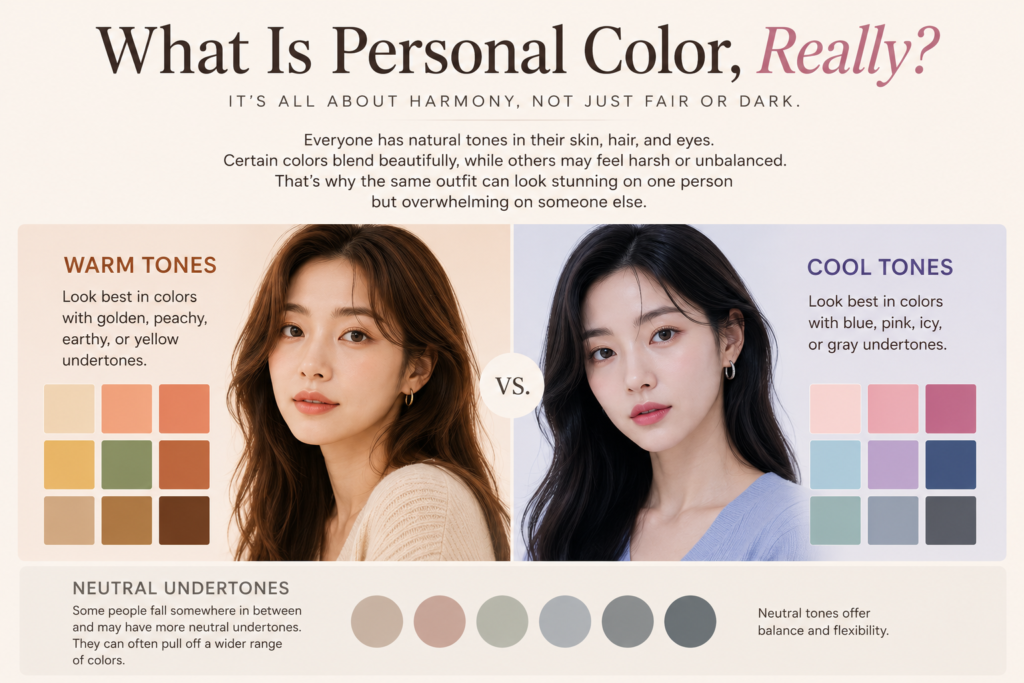
Every person has natural tones in their skin, hair, and eyes. Certain colors blend more naturally with those tones, while others create contrast that may feel harsh or unbalanced.
This is why the exact same outfit can look elegant on one person but overwhelming on someone else.
In most cases, personal color is divided into two broad categories:
- Warm tones
- Cool tones
Warm tones usually work better with colors that have golden, peachy, earthy, or yellow undertones.
Cool tones often look better in colors with blue, pink, icy, or gray undertones.
Some people also fall somewhere in between and may have more neutral undertones.
The Gold vs Silver Test
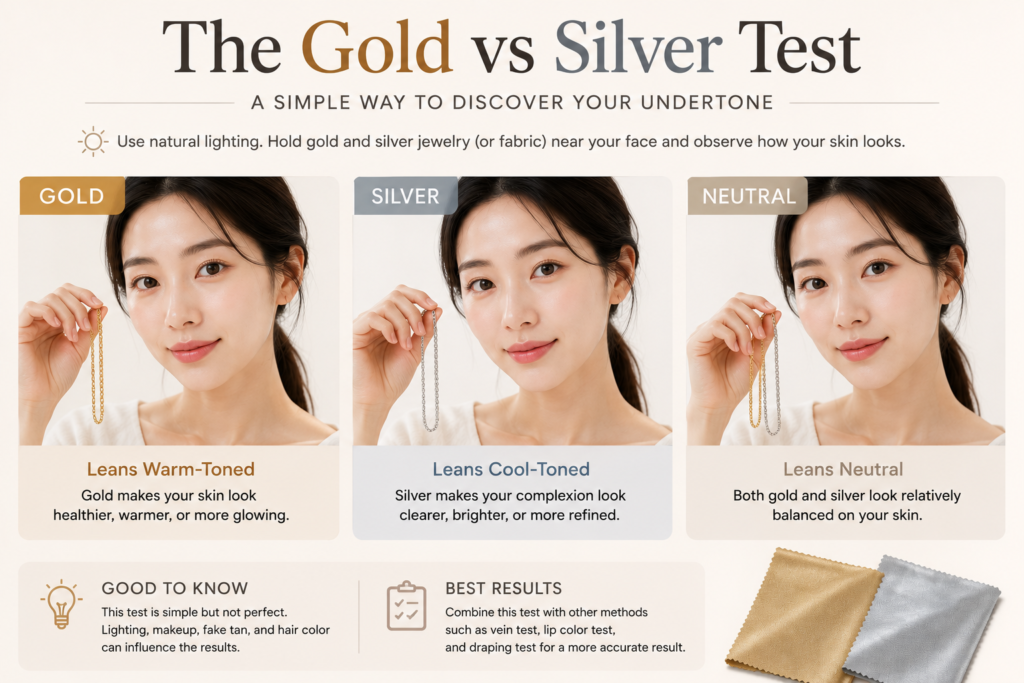
One of the easiest ways to begin is the classic gold versus silver test.
Try holding gold jewelry and silver jewelry near your face in natural lighting. You can also use gold and silver fabric if you have it.
Do not focus on which one you personally like more. Instead, look carefully at how your skin reacts.
If gold makes your skin appear healthier, warmer, or more glowing, you may lean warm-toned.
If silver makes your complexion appear clearer, brighter, or more refined, you may lean cool-toned.
People with neutral undertones sometimes notice that both look relatively balanced.
This test is popular because it is simple, but it is not perfect on its own. Lighting, makeup, fake tan, and even hair color can influence the results.
That is why it helps to combine several methods together.
Look at White vs Cream
Another surprisingly useful trick is comparing pure white clothing with cream or ivory tones.
Cool tones often look sharper and cleaner in bright white.
Warm tones usually look softer and healthier in cream, beige, or off-white shades.
If pure white makes your skin look gray or tired, there is a good chance your natural tones are warmer.
Meanwhile, if creamy beige shades make your face look dull, cooler tones may suit you better.
This is one reason some people feel amazing wearing crisp white shirts while others prefer softer neutral tones.
The Vein Test
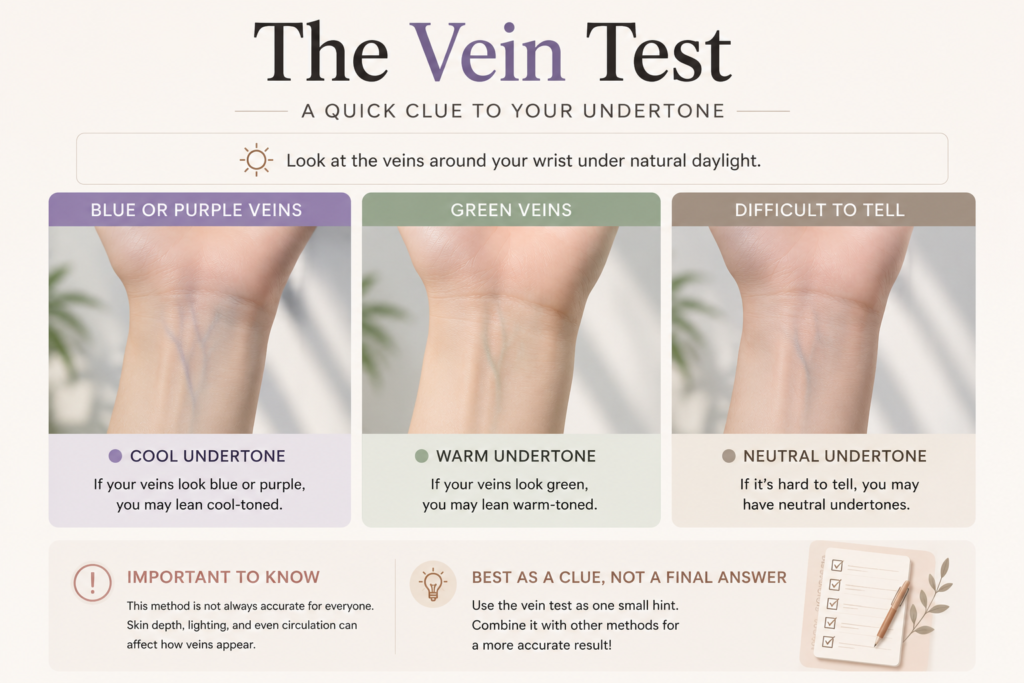
The vein test became popular online because it is quick and easy.
Look at the veins around your wrist under natural daylight.
If your veins appear more blue or purple, you may lean cool-toned.
If they look more green, you may lean warm-toned.
If it is difficult to tell, you may have neutral undertones.
However, this method is not always accurate for everyone. Skin depth, lighting, and even circulation can affect how veins appear.
It works best as a small clue rather than a final answer.
Lipstick Can Reveal More Than You Think
Many people accidentally discover their personal color through makeup.
Have you ever tried a lipstick that somehow made your entire face look healthier instantly?
Or one that made your complexion look strange no matter how much makeup you applied?
Warm-toned people often suit coral, peach, warm nude, terracotta, or orange-red lip colors.
Cool-toned people usually look better in rosy pinks, berry shades, cool mauves, or blue-based reds.
This is why trendy lip colors do not work equally well on everyone.
Sometimes a product itself is beautiful — it just does not harmonize with your natural coloring.
Why Some Colors Make You Look Tired
This is one of the most interesting parts of personal color theory.
The wrong color does not necessarily make someone “ugly.” Instead, it tends to create visual imbalance.
Certain shades can emphasize:
- redness
- dark circles
- sallowness
- uneven texture
- shadows around the mouth or eyes
Meanwhile, the right shades often soften these features naturally.
This is why some people suddenly look more awake wearing soft pink, while others appear healthier in camel, olive, or warm brown tones.
Color changes how the skin reflects light, which directly affects how fresh or tired the face appears.
Common Personal Color Mistakes
One of the biggest misconceptions is believing that pale skin automatically means cool tone.
That is not always true.
Someone can have very fair skin but still have warm undertones.
Likewise, deeper skin tones can absolutely be cool-toned.
Another common mistake is assuming that personal color is extremely strict.
In reality, it is more flexible than social media sometimes makes it seem.
You do not need to throw away your entire wardrobe because of one online test.
Personal color is simply a tool that helps you understand which shades naturally enhance your features.
It is not a rulebook.
Why Personal Color Became So Popular
Part of the reason personal color exploded in popularity is because people started realizing that makeup and fashion are not only about trends.
The same trendy color can look completely different depending on the person wearing it.
K-beauty especially helped popularize this idea by focusing on harmony and natural balance rather than dramatic transformation.
Today, many people use personal color not only for makeup, but also for:
- hair color
- fashion styling
- accessories
- nail colors
- wedding makeup
- professional photos
Some people even use it to build capsule wardrobes with colors that consistently suit them.
You Probably Already Know More Than You Think
Interestingly, many people instinctively avoid colors that do not suit them long before learning about personal color theory.
You may already notice that certain shades make you feel uncomfortable, tired, or overly pale.
At the same time, there are probably colors you naturally reach for because they make your face look more alive.
That instinct is often surprisingly accurate.
At the end of the day, personal color is not really about following strict beauty rules. It is about understanding harmony and finding colors that make you feel comfortable, confident, and balanced.
Sometimes even a small change in color can completely change the way your face looks — and once you notice it, it becomes difficult to unsee.
Leave a Reply