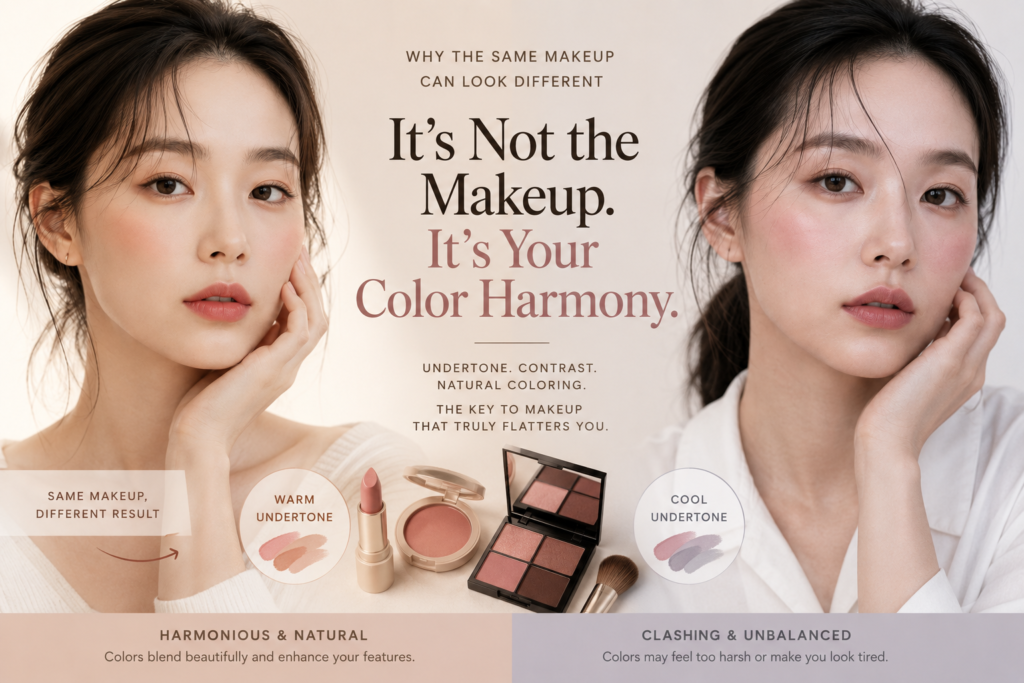
Have you ever tried a makeup trend that looked amazing on everyone else online — but somehow felt strange on your own face?
Maybe the lipstick looked too bright.
Maybe the blush suddenly made your skin look red.
Maybe the eyeshadow felt heavy even though the colors were beautiful.
This happens to almost everyone at some point.
And surprisingly, the problem is often not your makeup skills.
It is usually color harmony.
One of the biggest reasons makeup looks different from person to person is because every face has different undertones, contrast levels, and natural coloring. The exact same product can create completely different results depending on who is wearing it.
That is why personal color became such an important part of modern beauty.
Makeup Does Not Exist Separately From the Face
A lot of people think makeup itself creates beauty.
But makeup actually interacts with everything already present in the face:
- skin undertone
- eye color
- hair color
- facial contrast
- natural redness
- skin brightness
This means makeup is never viewed in isolation.
For example, a cool pink lipstick may look fresh and elegant on one person but make another person look pale or tired.
Meanwhile, a warm peach blush may create healthy warmth for some people while making others appear overly yellow or flushed.
The makeup itself did not change.
The harmony with the face changed.
Why Trendy Makeup Sometimes Feels “Too Much”
Many beauty trends are designed for visual impact.
On social media, stronger contrast often looks more dramatic and eye-catching on camera. Bright lips, sharp contour, icy shimmer, or heavily defined eyeliner may photograph beautifully under studio lighting.
But real life is softer.
Some trends that look stunning online can feel overwhelming in natural daylight, especially if they clash with someone’s natural coloring.
This is one reason people sometimes buy viral makeup products and then quietly stop using them after a few weeks.
The product is not necessarily bad.
It just may not match their personal coloring.
Warm Makeup vs Cool Makeup
One of the easiest ways to understand makeup harmony is through undertones.
Warm-toned makeup usually contains:
- peach
- coral
- golden beige
- orange-red
- warm brown
- terracotta
Cool-toned makeup often includes:
- rosy pink
- berry
- mauve
- plum
- blue-based red
- cool taupe
When makeup harmonizes with your undertones, the face tends to look smoother and more balanced naturally.
But when undertones fight each other, small imperfections become more noticeable.
For example:
- warm blush can exaggerate redness on cool skin
- icy lipstick can make warm skin look gray
- yellow foundation can dull cooler complexions
- ash tones can make warm skin appear tired
This is why undertone matters more than simply choosing “pretty colors.”
Why Foundation Is So Difficult to Match
Foundation problems are often connected to undertones too.
Many people focus only on whether a foundation is light or dark enough. But depth is only one part of the equation.
The hidden undertone matters just as much.
A foundation can technically match your skin depth while still looking unnatural if the undertone is too pink, too yellow, too gray, or too orange.
This is why some foundations look perfect indoors but strange outside.
Natural light reveals undertones very clearly.
Lipstick Reveals Personal Color Quickly
Lip products are often the easiest way to notice personal color differences.
Some lipsticks instantly brighten the face.
Others somehow make the skin look dull within seconds.
Warm-toned people often glow in:
- coral
- peach nude
- cinnamon
- warm brick red
Cool-toned people frequently suit:
- rose pink
- berry
- cool mauve
- cherry red
Of course, there are always exceptions. But in general, lip color tends to reveal undertone harmony very quickly because it sits directly near the center of the face.
Contrast Level Matters Too
Personal color is not only about warm versus cool tones.
Contrast level also changes how makeup appears.
People with naturally strong contrast — for example dark hair with lighter skin — can often carry bold makeup more easily.
Sharp eyeliner, dark lipstick, and dramatic eye makeup may feel balanced on them.
Meanwhile, people with softer contrast often look better in blended, muted, or natural makeup styles.
Heavy makeup can sometimes overpower delicate features rather than enhance them.
This is why “clean girl makeup” looks effortless on some people while others shine more with defined glam makeup.
The face itself influences how much visual intensity feels harmonious.
K-Beauty Popularized Softer Harmony
One reason K-beauty became globally influential is because it focused heavily on harmony instead of transformation.
Rather than dramatically changing facial structure, many Korean makeup styles aim to:
- soften the complexion
- enhance natural tones
- create balance
- make the skin appear healthy and calm
This approach works especially well with personal color analysis because the goal is not hiding the face, but supporting what already exists naturally.
That is also why many people discover they look better with softer makeup than with extremely heavy contour or overly trendy colors.
Makeup Should Support the Face, Not Fight It
A common mistake is believing makeup always needs to stand out.
In reality, the most flattering makeup often feels integrated with the face rather than sitting separately on top of it.
When color harmony works well:
- the skin looks clearer
- the eyes appear brighter
- the makeup feels natural
- the face appears more balanced overall
People may not even notice the makeup itself — they simply think the person looks healthy, elegant, or refreshed.
Personal Color Is a Tool, Not a Restriction
At the end of the day, personal color should not make beauty feel stressful.
You do not have to stop wearing trendy makeup completely just because it falls outside your ideal palette.
Fashion and beauty are also emotional and creative.
Sometimes people intentionally wear dramatic colors because they enjoy the mood or aesthetic they create.
But understanding undertones and harmony helps explain why certain makeup looks effortlessly beautiful on some faces while feeling slightly off on others.
Once you start noticing those patterns, makeup shopping becomes much easier — and much less random.
Leave a Reply