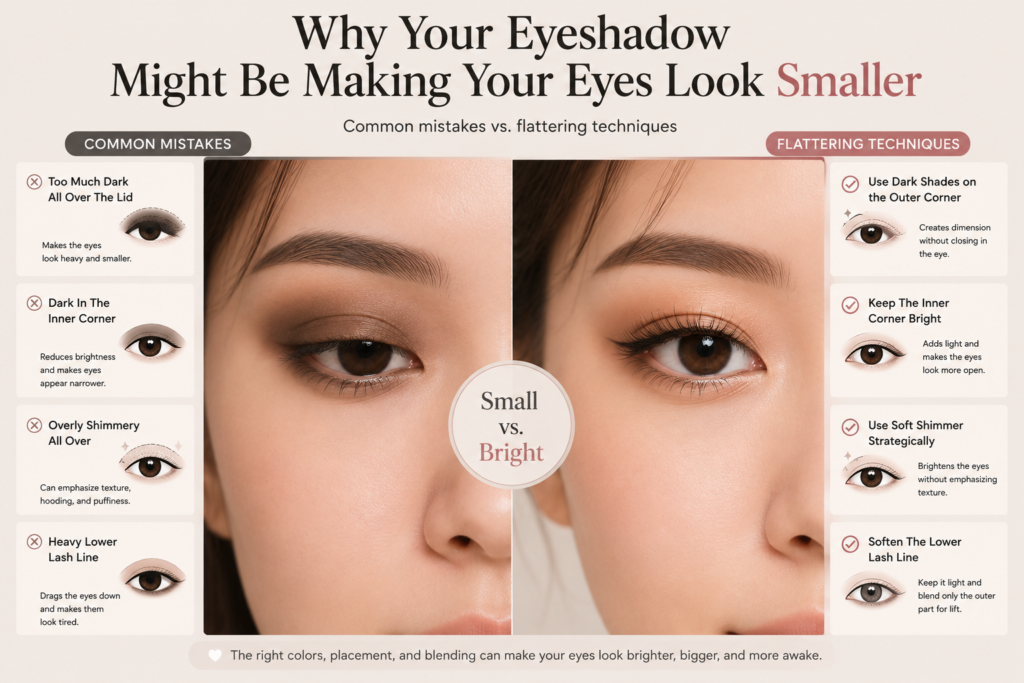
Have you ever spent twenty minutes carefully applying eyeshadow, only to feel like your eyes somehow looked smaller afterward?
It’s a surprisingly common problem.
Most people assume eyeshadow automatically makes the eyes look larger and more attractive. But depending on the colors, placement, and intensity, eyeshadow can sometimes have the exact opposite effect.
In fact, many of the techniques people copy from social media are designed for photos, not real life. What looks dramatic and beautiful on camera can easily make the eyes appear heavy, tired, or visually smaller in everyday lighting.
The good news is that the problem is usually not your eye shape.
More often, it’s a simple eyeshadow mistake.
One of the biggest mistakes is applying dark color across the entire eyelid.
Dark shades naturally create depth and make areas appear smaller. When a deep brown, black, or charcoal shade covers the whole lid, it can visually push the eyes backward.
This is especially noticeable on hooded eyes or smaller eyelids, where lid space is already limited.
Instead of creating definition, too much darkness can make the eyes disappear.
This doesn’t mean dark eyeshadow is bad. It simply works best when used strategically. Concentrating deeper shades on the outer corner often creates more dimension while keeping the eyes looking open.
Another common mistake is bringing the darkest color too far toward the inner corner.
The inner part of the eye naturally catches light. When that area becomes overly dark, the eyes can instantly appear narrower and more closed.
This is why many makeup artists keep the inner corner brighter and lighter than the outer corner.
That small contrast helps create the illusion of larger, more awake eyes.
Shimmer is another area where people often get confused.
Many assume that more sparkle equals bigger eyes.
Not necessarily.
A soft shimmer placed strategically can brighten the eyes beautifully. But covering the entire eyelid with intense glitter or metallic shadow can sometimes emphasize texture, hooding, or puffiness.
This is particularly true for mature eyelids, where reflective products may draw attention to areas people would rather soften.
A little brightness often looks more elegant than maximum sparkle.
The lower lash line is another place where mistakes happen frequently.
Many people bring dark shadow all the way underneath the eye because they think it creates definition.
Sometimes it does.
But if the shadow becomes too thick or too dark, it can create a shadow effect that visually drags the eyes downward.
Instead of looking larger, the eyes start looking heavier.
This is why softer shading concentrated on the outer third of the lower lash line often appears more flattering than a fully lined lower eye.
Color choice also matters more than people realize.
Some eyeshadow shades naturally make the eyes appear brighter, while others can create a tired appearance.
For example, certain gray tones can make warm-toned complexions look dull. Extremely warm orange-brown shades can sometimes overwhelm cooler complexions.
This is where personal color becomes important.
When eyeshadow harmonizes with your undertones, the eyes usually appear clearer and more defined without requiring extra makeup.
When the colors clash, even technically perfect application can feel slightly off.
Blending is another detail that separates soft, flattering eye makeup from eye makeup that feels heavy.
Harsh lines create visual blocks of color.
Soft transitions create dimension.
If eyeshadow suddenly changes from light to dark without a smooth gradient, the eye area can feel smaller and more crowded.
This doesn’t mean every look needs to be perfectly blended for ten minutes. But gentle transitions almost always create a more polished result.
One thing many people discover as they get older is that less eyeshadow often looks better than more eyeshadow.
When we’re younger, we tend to think adding more color creates more impact.
Over time, many people realize that carefully placed color creates far more beauty than simply using a larger amount of product.
The eyes remain the focus instead of the makeup itself.
Perhaps the biggest misconception about eyeshadow is the idea that there is one universal technique for everyone.
There isn’t.
An eyeshadow style that looks incredible on a beauty influencer may not work for your eye shape, lid space, facial contrast, or undertones.
That doesn’t mean you’re doing anything wrong.
It simply means makeup is personal.
The most flattering eyeshadow is rarely the most dramatic one. It’s usually the one that quietly makes the eyes look brighter, more open, and more awake without anyone immediately noticing why.
And once you understand that, eyeshadow becomes much less about following trends and much more about enhancing what is already there.
Leave a Reply