Most people think of makeup as something that starts with foundation.
But in reality, the difference between a natural, glowing look and something that feels slightly “off” often comes down to what happens before that—the base.
A makeup base isn’t just about making your skin smoother. When used correctly, it subtly changes how your entire face looks. It can brighten dull skin, neutralize redness, or even shift the overall tone of your complexion in a way that foundation alone can’t achieve.
And yet, this step is often overlooked or misunderstood.
Because the effect is subtle, many people assume it doesn’t matter. But once you start paying attention, you realize that choosing the right base color can completely change the final result.
Why Color Matters More Than Coverage
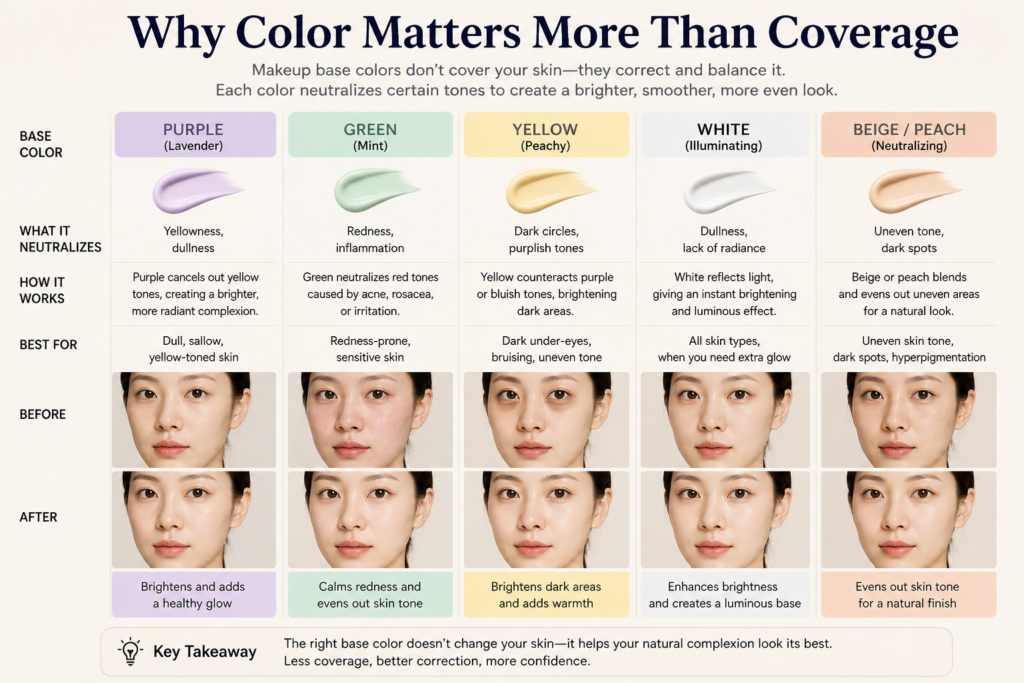
Unlike foundation, which is designed to match your skin tone, a makeup base works differently. It doesn’t aim to cover—it aims to adjust.
This is where color becomes important.
Different base colors interact with your natural skin tone in specific ways. Instead of masking your complexion, they shift it slightly, correcting small imbalances that might otherwise make your skin look dull, uneven, or tired.
For example, if your skin has a yellow undertone and appears a bit flat, a soft purple base can add brightness and create a clearer look. It doesn’t turn your skin purple—it simply counteracts the dullness.
Green bases are often used when there is visible redness. Rather than covering it with thicker foundation, the green tone neutralizes the red underneath, allowing your base makeup to look lighter and more natural.
White or light-reflecting bases, on the other hand, can enhance brightness and give your skin a more luminous finish. But when used incorrectly, they can also make your face look washed out.
That’s the balance.
The goal isn’t to dramatically change your skin color—it’s to refine it.
How to Choose the Right Base for Your Skin
The key is not to follow trends, but to understand what your skin actually needs.
If your skin tends to look dull or slightly yellow, a purple-toned base can help bring clarity. It’s especially useful when your complexion feels tired or lacks vibrancy.
If redness is your main concern—whether from sensitivity, breakouts, or uneven tone—a green base can soften that contrast and create a more even canvas.
For those who want a brighter, more radiant look, a light-reflecting or slightly white-toned base can enhance the overall glow. But this works best when applied lightly and blended well.
And then there are moments when you don’t need strong correction at all.
On days when your skin feels balanced, a neutral or hydrating base may be enough. Sometimes the best choice is simply to support your natural tone rather than adjust it.
What matters most is observation.
How does your skin look today? Slightly dull? A bit red? Already clear but lacking brightness?
The answer to that question should guide your choice—not habit.
The Difference Between Subtle and Noticeable
One of the reasons people struggle with makeup bases is expectation.
The effect is not meant to be obvious.
If you can clearly see the color after application, it’s probably too much. A well-applied base works quietly. You notice the result, not the product itself.
This is why application matters just as much as color selection.
A thin, even layer is enough. Over-applying doesn’t improve the effect—it often makes the skin look uneven or artificial. Blending is key, especially around the edges of the face where color differences can become more noticeable.
When done correctly, the base becomes almost invisible.
But the skin looks different—clearer, brighter, more balanced.
Why This Step Changes Everything
What makes makeup look natural isn’t just the products you use—it’s how well they work together.
When the base layer is properly adjusted, foundation sits better. You need less coverage, and the overall finish looks more like skin rather than makeup.
And perhaps more importantly, your face looks more “in sync.”
Nothing stands out too much. There’s no obvious mismatch between tone, texture, and light.
It’s subtle, but it’s the kind of subtlety that makes a noticeable difference.
Because in the end, makeup isn’t just about adding something new.
Sometimes, it’s about correcting just enough—so everything else falls into place naturally.
Leave a Reply