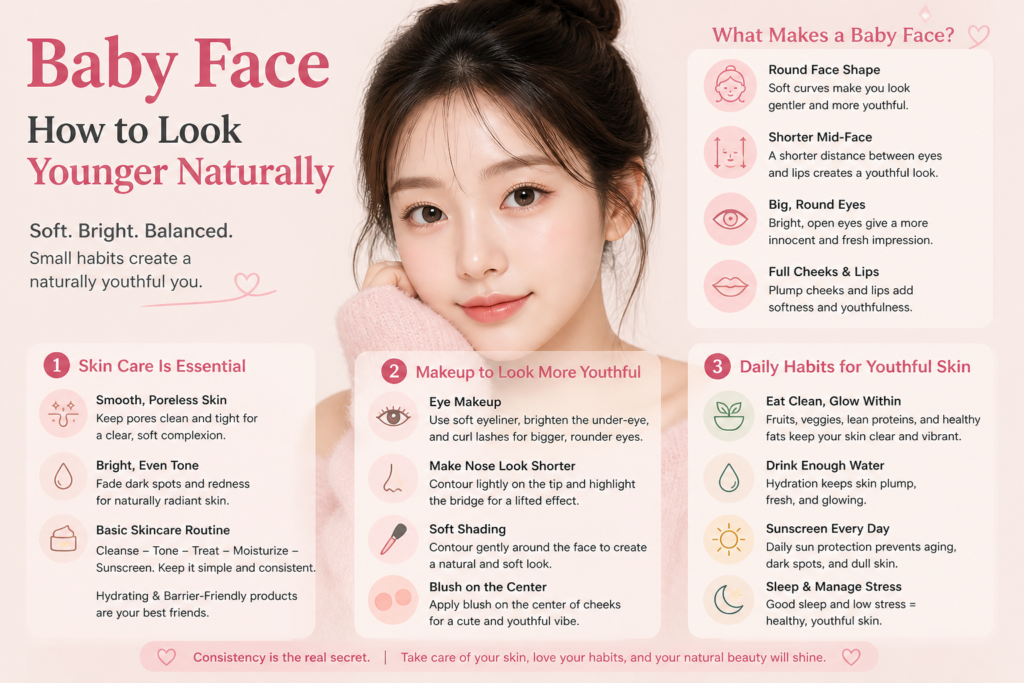
There’s a certain kind of face that people instinctively describe as “youthful.”
Not necessarily perfect, not heavily styled, and not overly dramatic—but soft, balanced, and naturally fresh. It’s often what people refer to as a “baby face,” a look that feels younger regardless of actual age.
And while genetics play a role, the idea of a youthful face is not random. There are patterns—subtle but consistent—that shape how we perceive age.
Understanding those patterns is where everything starts.
What Actually Defines a “Baby Face”?
When people talk about looking younger, they’re often reacting to a few specific visual cues, even if they don’t realize it.
A softer, rounder face shape is one of the most common. Sharp, angular features tend to read as more mature, while gentle curves create a more youthful impression. This doesn’t mean you need a perfectly round face, but balance and softness matter.
Proportions also play a role. A shorter mid-face—the area between your eyes and lips—often appears more youthful. When this area looks elongated, the face can appear more mature, even if everything else is the same.
Then there are the eyes.
Slightly rounder, more open-looking eyes tend to feel brighter and more energetic. It’s not about size alone, but about how awake and lifted they appear. Heavy, downward shapes can unintentionally create a tired or older impression.
None of these features exist in isolation. It’s the overall harmony—softness, proportion, and brightness—that creates what we recognize as a “baby face.”
Why Skin Quality Matters More Than You Think
Even with ideal facial structure, skin condition can completely change how young or old someone appears.
Smooth, even skin reflects light differently. It creates a kind of natural clarity that immediately reads as healthy and youthful. On the other hand, visible pores, uneven texture, and dullness can add visual weight to the face.
This is why skincare plays such a critical role.
It doesn’t need to be complicated, but it does need to be consistent.
A gentle cleansing routine that removes buildup without stripping the skin is essential. Over-cleansing can damage the skin barrier, leading to dryness and increased oil production—both of which disrupt that smooth, balanced look.
Hydration is equally important. Lightweight, layering-friendly products often work better than heavy creams, especially if your goal is a clear, fresh finish rather than a dense or overly glossy one.
Sun protection, though often overlooked, is one of the most defining habits. Daily sunscreen use helps maintain skin tone, prevent pigmentation, and protect the overall texture of your skin over time.
When the skin itself looks calm and even, everything else becomes easier.
Using Makeup to Reshape Perception, Not Features
Makeup, when used thoughtfully, doesn’t just enhance—it shifts how your face is perceived.
For a more youthful look, the goal isn’t to create sharper definition, but to soften and lift.
Eye makeup plays a central role. Instead of elongating the eyes too dramatically, slightly rounding the shape can create a more open, approachable look. Lighter shades toward the center of the eyelid and subtle definition at the outer corners help maintain that balance.
For the nose, heavy contouring can sometimes make features look more structured and mature. A softer approach—minimizing harsh shadows and focusing on light placement—can create the illusion of a shorter, more compact nose.
Shading overall should be used carefully.
Strong, angular contouring can add depth, but it can also make the face appear more defined in a way that reads as older. Blended, diffused shading tends to maintain softness while still adding dimension.
The key is subtlety.
Instead of transforming your features, you’re adjusting how light and shadow interact with them.
The Daily Habits That Make the Difference Over Time
While structure, skincare, and makeup all matter, daily habits are what sustain the result.
Hydration is one of the simplest, yet most overlooked factors. When your body is properly hydrated, your skin reflects that through improved elasticity and clarity.
Diet also plays a role. A balanced intake of nutrients, particularly those that support skin health, helps maintain a more stable and even complexion. It’s not about restriction, but about consistency.
Sleep is another quiet factor.
Lack of sleep doesn’t just make you feel tired—it changes how your skin looks. Dullness, puffiness, and uneven tone all become more noticeable when your body isn’t fully rested.
And finally, consistency.
There’s no single routine or product that creates a youthful look overnight. It’s the repetition of small, stable habits that builds that effect over time.
The Real Perspective
Looking younger isn’t about chasing a specific feature or copying a single trend.
It’s about understanding how softness, balance, and clarity come together—and then maintaining the conditions that support them.
A “baby face” isn’t something you either have or don’t have.
It’s something that can be enhanced, supported, and gradually shaped through the way you care for your skin, present your features, and maintain your daily habits.
And in the end, that approach tends to last longer than any quick transformation ever could.
Leave a Reply