Sometimes your skin changes before you even realize how stressed you are.
You sleep a little less. Your mind feels crowded. Your body feels tense without a clear reason. And then suddenly, your skin starts reacting too.
A breakout appears out of nowhere. Redness becomes harder to calm down. Your face looks more inflamed, more sensitive, more tired than usual.
And the frustrating part?
Your skincare routine hasn’t even changed.
A lot of people think stress breakouts are just a cliché people say casually, but dermatologists and skin researchers have been talking about this connection for years. Skin and stress are deeply connected—and once stress levels rise high enough, your skin usually notices quickly.
Sometimes before you do.
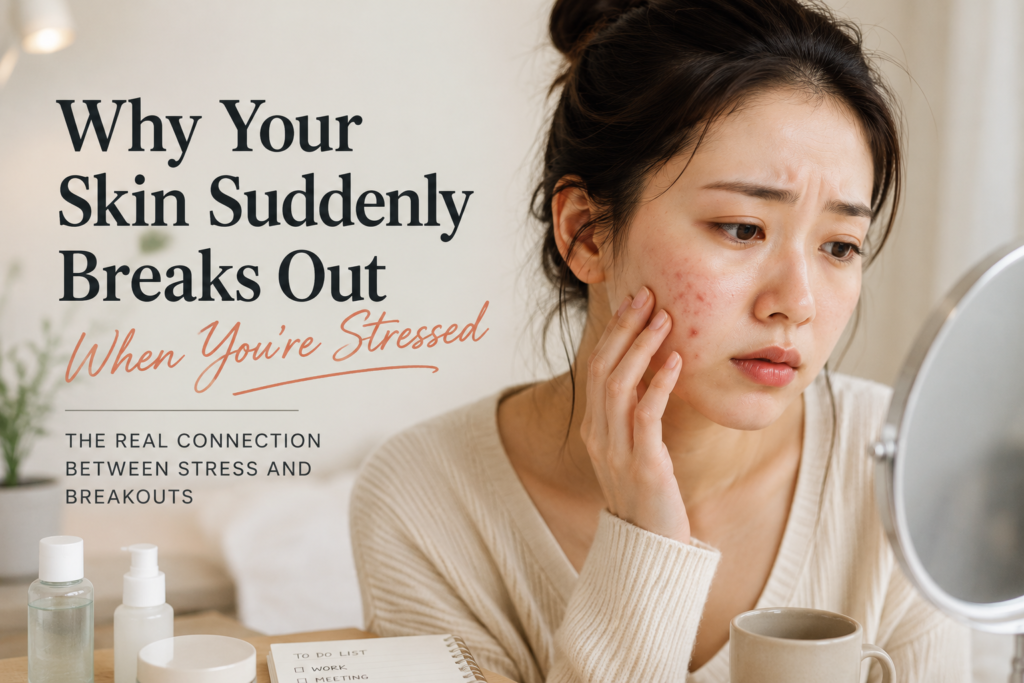
Your Skin Reacts to Stress Like the Rest of Your Body
Stress doesn’t only affect emotions.
It affects hormones, inflammation, sleep quality, circulation, oil production, and even how fast your skin heals. That’s why stressful periods often create multiple skin problems at once instead of just a single pimple.
When the body becomes stressed, cortisol levels rise.
Cortisol is often called the “stress hormone,” and one of its effects is increasing oil production in the skin. More oil itself is not always dangerous, but combined with inflammation and slower recovery, pores become more likely to clog and breakouts become harder to heal.
This is why stress acne often feels different from normal breakouts.
It can appear deeper, more inflamed, and more persistent.
And frustratingly, it often shows up during moments when people already feel emotionally exhausted.
Why Stress Breakouts Often Appear in Specific Areas
A lot of people notice stress breakouts appearing repeatedly in similar places:
- jawline
- chin
- cheeks
- around the mouth
Part of this is hormonal. Part of it is behavioral too.
When people are stressed, they unconsciously touch their face more often, sleep worse, drink less water, eat differently, or skip routines that normally help their skin stay balanced.
Stress also affects the skin barrier directly.
Skin becomes more reactive and loses moisture more easily during chronic stress. That’s why many people experience both acne and dehydration at the same time during difficult periods.
The skin becomes oilier… yet somehow more sensitive too.
The Sleep Connection Is Bigger Than Most People Realize
One bad night usually won’t destroy your skin.
But ongoing poor sleep changes a lot.
During deep sleep, the body repairs inflammation, restores hydration balance, and supports skin recovery. When sleep quality drops repeatedly, the skin often starts looking duller, puffier, and more reactive.
Breakouts also tend to heal more slowly.
This is one reason stress acne feels endless sometimes. The skin is not only breaking out more—it’s also recovering less efficiently at the same time.
And unfortunately, many people respond by becoming more aggressive with skincare.
More exfoliation. Stronger acids. More spot treatments.
But stressed skin usually becomes irritated skin very quickly.
Why “Perfect Skincare” Can’t Fully Fix Stress Skin
One of the hardest things to accept is that skincare has limits.
Products can support the skin. They can calm inflammation, hydrate the barrier, and reduce congestion. But if the body itself is overwhelmed for weeks or months, skin often reflects that internally.
This is why some people suddenly develop breakouts during exams, burnout periods, emotional stress, moving, relationship problems, or overwork—even when their skincare routine stays identical.
Skin is not isolated from life.
It responds to life constantly.
And interestingly, many dermatologists now talk about “skin wellness” instead of only skincare because stress management, sleep, hydration, and lifestyle affect skin more than most people expect.
The Hidden Cycle of Stress and Skin
Stress breakouts create another problem:
they often increase stress even more.
People start checking mirrors constantly. They panic-buy products. They pick at their skin more frequently. They become hyper-aware of every small change in texture or redness.
And ironically, that emotional stress can continue triggering inflammation.
The cycle feeds itself.
This is why calmer routines usually work better for stress-related skin issues than extreme routines do.
Gentle cleansing. Consistent hydration. Less picking. More sleep. Simpler routines. Less panic.
Skin tends to recover better in stable conditions.
What Actually Helps Stressed Skin Recover
The goal during stressful periods is not “perfect skin.”
It’s reducing additional damage while supporting recovery.
That usually means:
- avoiding over-exfoliation
- protecting the skin barrier
- sleeping consistently when possible
- drinking enough water
- simplifying routines temporarily
- reducing inflammation instead of attacking the skin aggressively
Sometimes skin improves dramatically once stress levels calm down—not because of a miracle product, but because the body itself finally feels safer again.
And honestly, that’s one of the most overlooked truths about skincare:
healthy-looking skin often reflects overall stability more than perfection.
Your skin notices how you live.
Even when you’re too busy to notice yourself.
Leave a Reply